
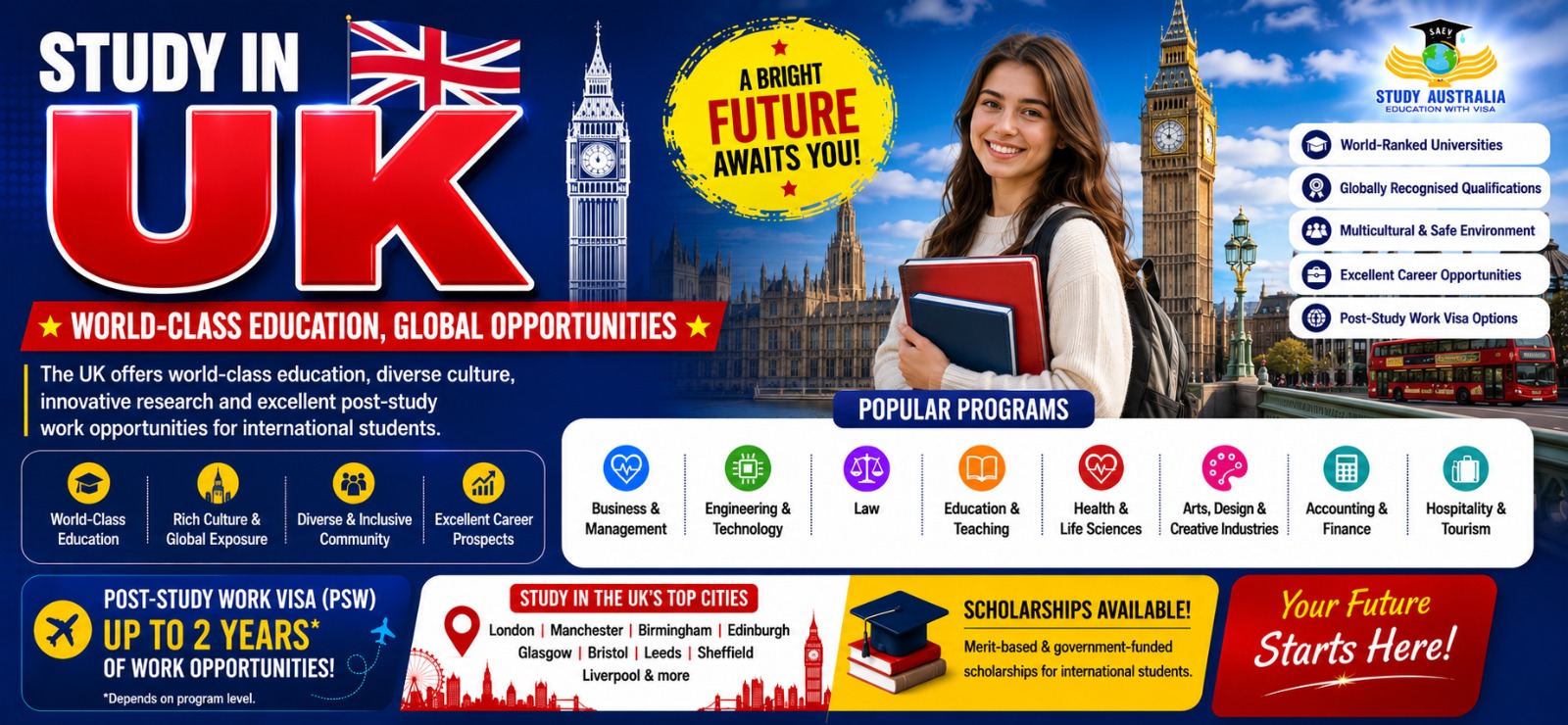
Study in UK
UK Universities List for September/January Intakes
The United Kingdom (UK), officially known as the United Kingdom of Great Britain and Northern Ireland, is a sovereign nation made up of four countries: England, Scotland, Wales, and Northern Ireland. England, Scotland, and Wales are located on the island of Great Britain, while Northern Ireland occupies the northern part of the island of Ireland, sharing the island with the independent Republic of Ireland.
In addition to these four countries, the UK also has several overseas territories, including Bermuda and Gibraltar. The United Kingdom has developed through a series of historical unions over the past three centuries. England and Scotland were once independent kingdoms with separate monarchs and governments, while Wales became part of the Kingdom of England. Ireland later joined the union, but following the establishment of the Republic of Ireland in 1922, Northern Ireland remained part of the United Kingdom, creating the political structure that exists today.
The British Empire was once one of the largest empires in history, with territories across Asia, Africa, North America, and other parts of the world. Although the colonial era has ended, the UK continues to be an important global economy and remains influential in education, business, research, and international affairs. It is one of the world’s leading financial centres and is well known for its diverse, multicultural society, shaped by people from many different countries and cultures. To learn more about the UK’s history and background, you can visit the official Wikipedia page: https://en.wikipedia.org/wiki/United_Kingdom.
The UK is one of the most popular study destinations for international students, welcoming hundreds of thousands of students from around the world every year. Its world-renowned universities, internationally recognised qualifications, and high academic standards make it an attractive choice for students seeking quality education. As the birthplace of the English language, the UK provides an ideal environment for students wishing to study in English while gaining valuable international exposure. With a strong higher education system and a wide range of academic programs, studying in the UK offers students an excellent opportunity to build successful global careers. This guide has been prepared to help prospective students learn more about studying in the UK, understand the education system, explore different regions, and prepare for student life in one of the world’s leading education destinations.
Why Study in the UK?
The United Kingdom is home to approximately 160 higher education institutions, offering a wide variety of undergraduate, postgraduate, and research programs. This extensive choice of universities and courses has made the UK one of the world’s preferred destinations for international education.
Although the education system differs slightly across England, Scotland, Wales, and Northern Ireland, students throughout the UK benefit from excellent teaching standards, modern learning facilities, and internationally respected qualifications. Degrees awarded by UK universities are recognised by employers and institutions worldwide, giving graduates a competitive advantage in the global job market.
UK universities consistently achieve high positions in international university rankings due to their outstanding teaching, research excellence, and innovation. The country has a long-standing tradition of academic excellence that continues to attract students from across the globe.
Some of the major reasons why international students choose the UK include:
- Globally recognised universities and qualifications
- High-quality education and academic excellence
- Affordable study options across many institutions
- Opportunities to work while studying
- Access to Europe for travel and cultural experiences
- A welcoming and multicultural society
For the latest statistics on international students studying in the UK, please visit the UK Council for International Student Affairs (UKCISA).
London is home to one of the world’s largest library collections, more than 300 languages are spoken across the city, and the UK has produced many internationally recognised authors, including J.K. Rowling.
Click here to see the list of UK universities.
UK Education System
Teaching excellence in the UK is recognised worldwide, making the country one of the leading destinations for higher education. Education in the UK is managed separately by four nations—England, Scotland, Wales, and Northern Ireland. While each nation has its own education policies, qualification frameworks, and regulations, they all maintain high academic standards. The main differences exist in the primary and secondary education systems, which have separate credit and qualification frameworks. Overall, around 160 universities and higher education institutions in the UK have the authority to award recognised degrees.
Study Levels
The UK education system is divided into four main stages:
- Primary Education
- Secondary Education
- Further Education
- Higher Education
Qualifications Framework
A qualifications framework serves as the national benchmark for maintaining the quality and academic standards of higher education qualifications. In the UK, two recognised frameworks are used by degree-awarding institutions:
- The Framework for Higher Education Qualifications (FHEQ) for degree-awarding bodies in England, Wales, and Northern Ireland.
- The Framework for Qualifications of Higher Education Institutions in Scotland (FQHEIS) for universities in Scotland.
Quality Assurance System
One of the strengths of the UK education system is the Quality Assurance Agency (QAA). This independent organisation is responsible for reviewing and monitoring the quality of higher education institutions through regular audits and assessments. The QAA also promotes best practices and provides recommendations to help universities continuously improve their academic standards. As a result, students can be confident in receiving a high-quality education. Review reports published by the QAA are publicly available through its official website. However, it is important to note that private institutions are not always reviewed by the QAA.
Higher Education
Higher education in the UK mainly includes Bachelor’s, Master’s, and Doctoral degrees. International students who do not meet direct entry requirements may also enrol in pathway programmes, which commonly include foundation courses and English language preparation before progressing to university-level study.
Undergraduate Courses
Undergraduate programmes are designed to provide students with in-depth knowledge in their chosen field while developing practical and professional skills. UK universities offer a wide range of courses across disciplines such as business, engineering, science, technology, humanities, social sciences, arts, and design.
Below is an overview of common undergraduate qualifications available in the UK:
| Program | Duration |
| Higher National Certificate (HNC) or Diploma (HND) | 1 to 2 years |
| Certificates or Diplomas of Higher Education (Cert HE/Dip HE) | 1 to 2 years |
| Foundation degrees (Fd A/Fd Sc) | 6 months to 2 years |
| Degrees (such as BA, B.Sc, BEng) | 3 years in England, Wales and Northern Ireland 4 years in Scotland |
| Sandwich degrees | 4 years with a year in industry |
| Integrated courses (where masters is awarded as the first degree such as MEng) | 4 years |
Postgraduate Studies
Postgraduate programmes offer specialised knowledge and advanced academic or professional training. Most taught Master’s degrees in the UK can be completed within one year, allowing graduates to enter the workforce sooner than in many other countries. Universities also offer a wide variety of specialised programmes that are highly valued by employers.
Below is an overview of common postgraduate qualifications available in the UK:
| Program | Duration |
| Postgraduate Certificate or Diploma (PG Cert/PG Dip) | 9 to 12 months |
| Taught Master’s Degree (MA, MSc, LLM, MBA, MRes) | 1 year |
| Research Master’s Degree (MPhil, PhD, DPhil) | 2 to 3 years |
Pathway Programs
Pathway programmes are designed for students who require additional academic preparation or English language support before beginning a university degree. These programmes usually include foundation studies and English language courses, helping students meet university entry requirements and smoothly progress into undergraduate or postgraduate programmes. Both universities and private education providers offer pathway options for international students.
UK Fees for International Students
The cost of studying in the UK varies depending on several factors, including the university or college you choose, the location of the institution, the type of course, and the duration of your program. Tuition fees differ between institutions, so the figures below should be considered as general estimates for international students. Fees for other qualifications, such as A-Levels and GCSEs, can vary significantly, so it is recommended that students contact the relevant institution directly for the latest information.
ESL Programs
If you are planning to enrol in an English as a Second Language (ESL) program, it is important to compare different schools before making a decision. Consider factors such as the institution’s location, student support services, class size, and overall learning environment. While London is one of the most popular destinations for international students, living and studying there is generally more expensive than in many other parts of the UK. Exploring institutions in other cities may help reduce your overall study and living costs while giving you the opportunity to experience different regions of the country.
For more information about English language schools, you can visit the ESL Directory, which provides a comprehensive online database of ESL institutions worldwide.
Your tuition fees will depend on the qualification you choose, the university or college, your study level, and the location of the institution. Universities across England, Scotland, Wales, and Northern Ireland have their own fee structures. Generally, courses in humanities, arts, and education are more affordable than professional programs such as medicine, dentistry, and engineering. Postgraduate tuition fees are usually higher than undergraduate fees, and MBA programs are often among the most expensive qualifications offered by UK universities.
| S.No. | Study Program | Average Fee |
| 1 | Undergraduate Bachelor’s Degree | GBP 10,000 – GBP 20,000 per year |
| 2 | Postgraduate Master’s Degree | GBP 10,000 – GBP 20,000 per year |
| 3 | Doctoral (PhD) Degree | GBP 15,000 – GBP 24,000 per year |
Please Note: The above figures are intended as a general guide only. Actual tuition fees vary by university and program. Some PhD programs may be fully funded, which can significantly reduce or cover tuition costs.
Accommodation Cost
Most universities in the UK provide on-campus accommodation, commonly known as Halls of Residence, for international students. These may be available as self-catered or fully catered options. Some universities also offer shared houses or flats for students who prefer independent living. Staying in university-managed accommodation is often one of the most convenient and affordable options, especially during the first year of study. However, applications should be submitted well in advance, as places are limited.
If on-campus accommodation is unavailable, students can choose from private rental properties, homestays, or shared accommodation. University accommodation offices usually assist students by providing information about suitable housing options near campus.
Before choosing accommodation, students should carefully consider the following:
- Rental cost
- Available facilities
- Security deposit
- Property inventory
- Rent records
- Utility bill arrangements
- Tenancy agreement
- Council tax obligations
- House rules and regulations
Accommodation expenses vary depending on the city and the type of housing selected. Students renting private accommodation should also budget for additional costs such as electricity, gas, water, internet, and, in some cases, tenant insurance. As a general guide, renting a one-bedroom apartment may cost approximately £550–£650 per month, although prices differ by location.
Individuals aged 18 or above who live in private accommodation may also be required to pay Council Tax, unless they qualify for an exemption, such as being a full-time student. Students should always read and understand their tenancy agreement before signing any rental contract.
Many universities provide assistance in finding both on-campus and off-campus accommodation. According to the NUS/Unipol Accommodation Costs Survey, London has one of the highest average weekly accommodation costs at approximately £157.48 per week, while some of the most affordable student accommodation can be found in Northern Ireland, with average weekly rents starting from around £83.01 per week.
Scholarships to Study in the UK
Institutions in the UK Offering Scholarships
Many universities and higher education institutions in the UK provide scholarships for international students. The value and type of scholarship vary depending on the institution and the program of study. Some research-based courses may offer scholarships covering up to 100% of the tuition fee, along with a contribution towards living expenses.
Government-funded scholarships are usually highly competitive because they attract applicants from around the world. Therefore, students are encouraged to begin their scholarship search and application process 8–12 months before their intended intake.
Below are some of the most popular scholarship opportunities available for Bangladeshi students wishing to study in the UK.
| S. No. | Name of the Scholarship | Description |
| 1 | Chevening Scholarship | Chevening is the UK Government’s prestigious global scholarship programme for outstanding professionals who demonstrate leadership potential and academic excellence. Scholarships are awarded through British Embassies and High Commissions worldwide. The scholarship is fully funded and generally covers tuition fees, airfare, living expenses, and other approved costs. It is normally awarded for one-year Master’s programmes, with extensions considered only in exceptional circumstances and subject to approval. Source: https://www.chevening.org/current-cheveners/policies/terms-and-conditions-scholarships/ |
| 2 | Commonwealth Scholarship and Fellowship | The Commonwealth Scholarship Commission (CSC) provides scholarships and fellowships to students from eligible Commonwealth countries, including Bangladesh. These scholarships are available primarily for Master’s and PhD programmes and are intended to support talented students from low and middle-income Commonwealth nations. Funding typically includes tuition fees, airfare, and a contribution towards living expenses. Source: https://study-uk.britishcouncil.org/scholarships/commonwealth-scholarships |
| 3 | GREAT Scholarships | GREAT Scholarships are jointly funded by the UK Government’s GREAT Britain Campaign and the British Council in partnership with participating UK universities. These scholarships are available for a range of postgraduate taught programmes. Scholarship values generally start from £10,000 towards tuition fees. Availability, eligibility requirements, and application deadlines differ between universities, so applicants should refer to the official website of their chosen institution. Source: https://study-uk.britishcouncil.org/scholarships/great-scholarships |
| 4 | Charles Wallace Scholarships | The Charles Wallace scholarship programmes support students and professionals specialising in arts, heritage conservation, culture, and the humanities. Depending on the scheme, applicants may receive funding for research, doctoral studies, professional visits, fellowships, or specialised training programmes. The value and duration of each award vary according to the category of scholarship and the host institution. Applicants should refer to the official programme guidelines for detailed eligibility criteria and funding information. Source: https://study-uk.britishcouncil.org/scholarships |
| 5 | Scotland’s Saltire Scholarships | Scotland’s Saltire Scholarships are funded by the Scottish Government in collaboration with participating Scottish universities. The programme supports international students pursuing one-year full-time Master’s degrees in subjects such as science, healthcare, technology, renewable energy, and creative industries. Each successful applicant may receive a scholarship worth £8,000, which contributes towards tuition fees. Source: https://www.scotland.org/study/saltire-scholarships |
Please Note: The above scholarships are provided as a general guide. Eligibility requirements, scholarship values, available courses, and application deadlines may change from year to year. Applicants should always refer to the official scholarship or university website for the latest information before applying.
In addition to government-funded scholarships, most UK universities and colleges also offer their own scholarships, bursaries, and tuition fee discounts for international students, including students from Bangladesh.
PSW Visa in UK
Here is an overview of the main UK study visa categories and their general application requirements.
| Type of Student Visa | Who It Is For | When to Apply | Arrival in the UK |
| Student Visa | Students aged 16 years or older who have received an offer to study at a UK institution licensed to sponsor international students. | You can normally apply up to 6 months before your course starts if applying from outside the UK. | You may usually travel to the UK up to one month before your course begins if your course lasts more than six months. |
| Child Student Visa | Students aged 4 to 17 years who have been offered a place at an independent school in the UK that holds a valid student sponsor licence. | You can normally apply up to 6 months before the course start date. | Students are generally allowed to arrive up to one month before the course starts if studying for more than six months. |
| Short-term Study Visa | Students enrolled in a short English language course lasting more than 6 months and up to 11 months. | Apply before your planned travel date, allowing sufficient time for visa processing. | Entry to the UK depends on the approved travel dates stated on your visa. |
For the latest and most accurate visa information, please visit the official GOV.UK website.
Eligibility for a UK Student Visa
To apply for a UK Student Visa, applicants generally must:
- Have an unconditional offer from a UK education provider that is licensed to sponsor international students.
- Receive a Confirmation of Acceptance for Studies (CAS) from the institution.
- Demonstrate the required level of English language proficiency.
- Provide evidence of sufficient funds to cover tuition fees and living expenses.
- Meet all UK immigration requirements applicable to their course and personal circumstances.
For a Short-term Study Visa, applicants must also demonstrate that they intend to leave the UK before their visa expires after completing their course.
Documents Required for a UK Student Visa
Applicants are generally required to provide:
- A valid passport or other recognised travel document.
- A Confirmation of Acceptance for Studies (CAS) reference number.
- Evidence of sufficient financial resources to pay tuition fees and living expenses.
- Recent passport-sized colour photographs (if required).
- Tuberculosis (TB) test certificate (where applicable).
- Academic certificates and supporting admission documents.
- Academic Technology Approval Scheme (ATAS) certificate, if required for the chosen course.
Additional Documents May Be Required If You:
- Are applying from a country other than your country of citizenship.
- Are under 18 years of age.
- Are travelling with or applying for dependants.
- Are requested to provide additional supporting documents by UK Visas and Immigration (UKVI).
Graduate Route (Post-Study Work Visa)
International students who successfully complete an eligible degree in the UK may be able to apply for the Graduate Route, allowing them to remain in the UK after graduation to work or look for employment.
- Bachelor’s and Master’s graduates: Eligible to stay and work in the UK for 18 months after successfully completing their studies.
- PhD graduates: Eligible to stay and work in the UK for 3 years after completing their doctoral degree.
For the latest information about the Graduate Route and post-study work opportunities, please visit the official GOV.UK website.