
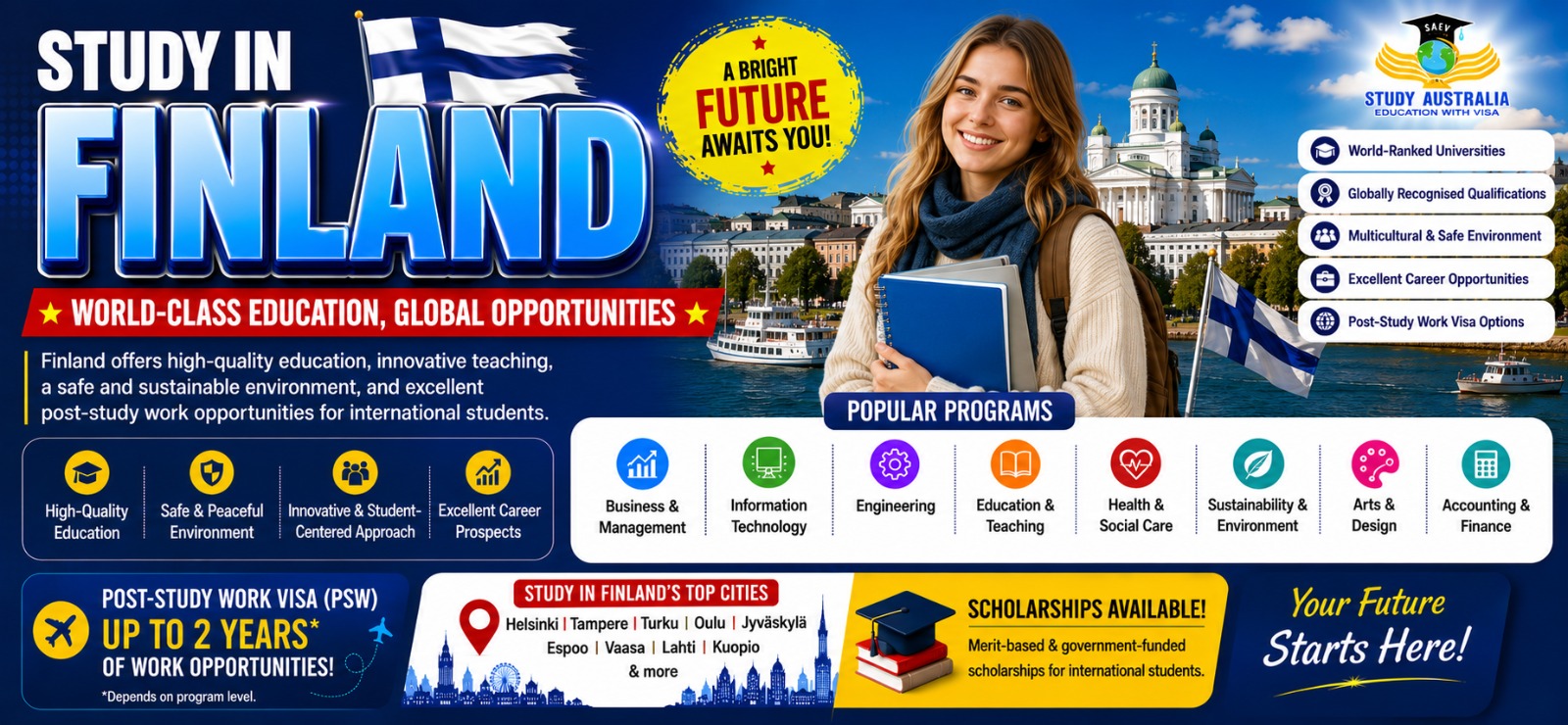
Finland, officially known as the Republic of Finland, is a Nordic country located in Northern Europe. It shares borders with Sweden to the west, Norway to the north, and Russia to the east, while the Gulf of Bothnia and the Gulf of Finland surround its coastline. Finland is well known for its beautiful natural landscapes, thousands of lakes and forests, high standard of living, and one of the world’s most advanced education systems.
The country has built a strong international reputation for academic excellence, innovation, and research. Finnish universities are recognised globally for providing high-quality education, modern teaching methods, and strong industry collaboration. Degrees awarded by Finnish higher education institutions are respected worldwide, making Finland an attractive destination for students seeking internationally recognised qualifications.
Each year, thousands of international students choose Finland for higher education because of its safe environment, excellent quality of life, and student-friendly culture. Universities offer a wide range of Bachelor’s, Master’s, and Doctoral programmes, with many courses taught entirely in English. Students also benefit from modern campuses, advanced research facilities, and opportunities to gain practical experience through internships and industry partnerships.
Finland is consistently ranked among the happiest, safest, and most innovative countries in the world. The country’s commitment to equality, sustainability, and technological advancement creates an ideal environment for both academic and personal development. International students enjoy a welcoming multicultural community and a balanced lifestyle while studying in Finland.
This guide has been prepared to help Bangladeshi students understand the Finnish education system, university options, tuition fees, scholarships, student visa requirements, accommodation, and post-study opportunities before beginning their study journey.
Why Study in Finland?
Finland has become one of Europe’s leading destinations for international education. Its universities combine academic excellence with practical learning, ensuring graduates are well prepared for global careers.
Some of the key reasons why Bangladeshi students choose Finland include:
- Globally recognised universities and degrees.
- High-quality education based on innovation and research.
- Modern teaching methods with practical learning opportunities.
- English-taught Bachelor’s and Master’s programmes.
- Safe, peaceful, and student-friendly environment.
- Opportunities for part-time work during studies.
- Excellent post-graduation career opportunities.
- Strong links between universities and industry.
- Multicultural campuses welcoming students from around the world.
- A high standard of living and outstanding quality of life.
Finnish universities focus on developing critical thinking, creativity, teamwork, and problem-solving skills rather than relying solely on examinations. Students benefit from small class sizes, interactive teaching, and close collaboration with academic staff.
Finland is also recognised as one of the world’s most innovative countries, making it an excellent destination for students interested in technology, engineering, business, information technology, healthcare, education, environmental sciences, and research.
Click here to see the list of Finland universities.
Finland Education System
Teaching excellence in Finland is recognised worldwide, with the country consistently being acknowledged for its high-quality, student-centred approach to education. Finland’s higher education system is overseen by the Ministry of Education and Culture, ensuring that universities maintain strong academic standards and deliver internationally recognised qualifications. Finnish institutions place a strong emphasis on innovation, research, practical learning, and collaboration with industry.
Study Levels
The education system in Finland consists of the following stages:
- Early Childhood Education and Care
- Basic Education (Comprehensive School)
- Upper Secondary Education (General or Vocational)
- Higher Education
International students generally enter the higher education sector through Bachelor’s, Master’s, or Doctoral degree programmes.
Higher Education Institutions
Finland has two types of higher education institutions:
- Universities – Focus on scientific research and academic education, offering Bachelor’s, Master’s, and Doctoral degrees.
- Universities of Applied Sciences (UAS) – Focus on professionally oriented education with strong links to industry and practical training, preparing students for the workforce.
Both types of institutions award internationally recognised qualifications and provide excellent opportunities for further study and career development.
Qualifications Framework
Finland’s higher education qualifications are aligned with the European Qualifications Framework (EQF) and the Finnish National Qualifications Framework (NQF). These frameworks ensure that qualifications awarded by Finnish institutions meet internationally recognised academic standards and are comparable across Europe.
Quality Assurance System
The quality of higher education in Finland is supported through national quality assurance processes coordinated by the Finnish Education Evaluation Centre (FINEEC). Universities are regularly evaluated to ensure they maintain high academic standards, continuously improve teaching quality, and provide an excellent learning environment for students.
Higher Education
Higher education in Finland includes Bachelor’s, Master’s, and Doctoral programmes. Many universities also offer English-taught degree programmes, particularly at the Master’s level. Students benefit from modern learning facilities, research opportunities, digital learning environments, and close collaboration with industry.
Undergraduate Courses
Bachelor’s degree programmes provide students with both theoretical knowledge and practical skills in their chosen field. Finnish higher education institutions offer programmes across a wide range of disciplines, including:
- Business
- Engineering
- Information Technology
- Health Sciences
- Hospitality and Tourism
- Environmental Sciences
- Education
- Arts and Design
- Social Sciences
- Natural Sciences
Below is an overview of common undergraduate qualifications available in Finland:
| Program | Duration |
| Bachelor’s Degree (University of Applied Sciences) | 3.5–4.5 years |
| Bachelor’s Degree (University) | 3 years |
Postgraduate Studies
Master’s programmes in Finland are designed to provide advanced academic knowledge, specialised professional skills, and research experience. Students can choose from a wide range of English-taught programmes offered by Finnish universities across various disciplines.
Below is an overview of common postgraduate qualifications available in Finland:
| Program | Duration |
| Master’s Degree | 2 years |
| Licentiate Degree (selected fields) | Varies |
| Doctoral Degree (PhD/Doctorate) | Approximately 4 years (full-time) |
Pathway Programs
Students who do not meet the direct entry requirements for a degree programme may have the opportunity to improve their academic qualifications or English language proficiency through pathway or preparatory studies offered by some institutions. Admission pathways vary between universities, so applicants should review the specific requirements of their chosen institution before applying.
Finland Fees for International Students
The cost of studying in Finland depends on several factors, including the university, the degree programme, the level of study, and the student’s nationality. Tuition fees are generally charged for non-EU/EEA international students enrolled in English-taught Bachelor’s and Master’s programmes. The exact tuition fee varies from one institution to another, so students should always check the official university website for the latest information.
English Language Programs
Students who need to improve their English language proficiency before starting a degree programme can choose from a range of English language courses offered by universities and private language institutions. When selecting a language school, it is important to consider factors such as the quality of teaching, student support services, class size, location, and tuition fees. Students are encouraged to compare different providers before making a decision.
Tuition fees in Finland vary depending on the university and programme. In general, programmes in medicine, engineering, and business may have higher tuition fees than some humanities or social science programmes. Many Finnish universities also offer scholarships or tuition fee discounts for outstanding international students.
| S.No. | Study Program | Average Tuition Fee |
| 1 | Bachelor’s Degree | EUR 6,000 – EUR 18,000 per year |
| 2 | Master’s Degree | EUR 8,000 – EUR 20,000 per year |
| 3 | Doctoral Degree | Generally tuition-free at public universities (subject to university regulations) |
Please Note: The above figures are indicative only. Tuition fees vary between universities and study programmes. Doctoral education at Finnish public universities is generally tuition-free, although students are responsible for their living expenses.
Accommodation Cost
Most Finnish universities assist international students in finding suitable accommodation. Students can choose from student housing, university-managed accommodation, shared apartments, or private rental apartments. Student housing is usually the most affordable option and is managed by local student housing foundations or organisations in each city.
As demand for student accommodation can be high, students are advised to apply as early as possible after receiving their admission offer.
When choosing accommodation, students should consider:
- Monthly rent
- Location and transport access
- Facilities and furnishings
- Security deposit
- Utility costs
- Internet availability
- Rental agreement
- House rules and maintenance responsibilities
Accommodation costs vary depending on the city, type of accommodation, and location. Cities such as Helsinki, Espoo, and Vantaa generally have higher rental costs than smaller cities. On average, students should budget approximately EUR 250–600 per month for student accommodation, while private apartments may cost more depending on the location and size.
In addition to rent, students may need to pay for utilities such as electricity, water, and internet if these are not included in the rental agreement. Students should carefully read and understand the tenancy agreement before signing any housing contract.
Many universities also provide accommodation guidance and can help international students connect with recognised student housing providers before arriving in Finland.
Scholarships to Study in Finland
Institutions in Finland Offering Scholarships
Many Finnish universities offer scholarships to international students to help reduce the cost of tuition. Scholarship opportunities, eligibility criteria, and award values vary from one institution to another. Most scholarships are available for non-EU/EEA students enrolling in Bachelor’s or Master’s degree programmes taught in English. Some universities offer full or partial tuition fee waivers, while others may also provide relocation grants or scholarships to assist with living expenses.
Since scholarship places are limited and highly competitive, students are encouraged to begin their application process 8–12 months before their intended intake.
Below are some of the most common scholarship opportunities available for Bangladeshi students planning to study in Finland.
| S. No. | Name of the Scholarship | Description |
| 1 | Finnish Government Scholarship Pool | The Finnish Government Scholarship Pool supports doctoral-level studies and research in Finland through agreements with selected countries. The scholarship is generally intended for research visits and doctoral studies rather than Bachelor’s or Master’s programmes. Eligibility and availability depend on current government policies and participating countries. |
| 2 | University Scholarship Programmes | Almost all Finnish universities offer scholarships for international students admitted to English-taught Bachelor’s and Master’s degree programmes. Depending on the university, scholarships may cover 50%, 75%, or 100% of the tuition fee. Some institutions also provide early-bird discounts or performance-based scholarships for students who achieve excellent academic results during their studies. |
| 3 | University of Applied Sciences (UAS) Scholarships | Many Universities of Applied Sciences (UAS) provide tuition fee scholarships for international students. Scholarship schemes vary by institution and may include first-year tuition discounts, merit-based awards, or scholarships based on academic performance throughout the programme. |
| 4 | EDUFI Fellowships | EDUFI Fellowships are administered by the Finnish National Agency for Education and are mainly intended for international doctoral students and researchers. These fellowships are generally awarded through Finnish universities and support research collaboration rather than undergraduate or taught Master’s studies. |
| 5 | Programme-Specific Scholarships | Some universities offer additional scholarships for selected degree programmes or academic disciplines. The value, eligibility requirements, and application deadlines vary depending on the university and the programme chosen. Applicants should review the scholarship information available on the official university website before applying. |
Please Note: Scholarship availability, eligibility criteria, tuition fee waivers, and application deadlines differ between universities and may change each academic year. Students should always check the official website of their chosen university for the most up-to-date scholarship information.
In addition to university scholarships, students are encouraged to explore external funding opportunities offered by international organisations, foundations, and government agencies. Applying early and maintaining a strong academic record can significantly improve the chances of receiving financial assistance.
Finland Student Visa
Here is an overview of the main study residence permit and its general application requirements.
| Type of Permit | Who It Is For | When to Apply | Arrival in Finland |
| Residence Permit for Studies | International students who have been admitted to a full-time degree programme at a recognised Finnish higher education institution. | Students should apply as soon as they receive their official admission letter and pay the required tuition fee (if applicable). It is recommended to apply 2–3 months before the course commencement date. | Students may travel to Finland after their residence permit has been granted and according to the validity period stated on the permit. |
| Residence Permit for Exchange Studies | Students participating in an approved exchange programme between their home institution and a Finnish higher education institution. | Apply after receiving confirmation of participation in the exchange programme. | Entry is permitted once the residence permit has been approved and issued. |
| Residence Permit for Research | International researchers or doctoral candidates undertaking approved research at a recognised Finnish institution. | Apply after receiving the official invitation or research agreement from the host institution. | Travel to Finland after the residence permit has been granted. |
For the latest information on residence permits, please visit the official Finnish Immigration Service (Migri) website.
Eligibility for a Finland Student Residence Permit
To apply for a Residence Permit for Studies, applicants generally must:
- Receive an official admission offer from a recognised Finnish higher education institution.
- Be enrolled in a full-time degree programme.
- Hold a valid passport.
- Demonstrate sufficient financial resources to support themselves during their stay in Finland.
- Obtain comprehensive health insurance that meets Finnish immigration requirements.
- Pay the applicable tuition fee if required by the university.
- Meet all Finnish immigration requirements before travelling.
Documents Required for a Finland Student Residence Permit
Applicants are generally required to submit:
- A valid passport.
- Official admission letter from a recognised Finnish institution.
- Proof of tuition fee payment (if applicable).
- Evidence of sufficient financial resources.
- Valid health insurance covering the required period.
- Passport-sized photograph.
- Completed residence permit application.
- Any additional documents requested by the Finnish Immigration Service (Migri).
Additional Documents May Be Required If You:
- Are under 18 years of age.
- Have family members applying as dependants.
- Need to provide additional financial or identity documents.
- Are requested to submit further supporting documents during application processing.
Work Rights During Study
International students holding a Finnish residence permit for studies are generally allowed to work during their studies, subject to the conditions set by Finnish immigration regulations. Students may also work full-time during official holiday periods if permitted under the applicable rules.
Post-Study Residence Permit
After successfully completing an eligible degree in Finland, international graduates may apply for a Residence Permit to Look for Work or Start a Business.
This permit allows graduates to:
- Stay in Finland after graduation to search for employment.
- Start their own business if they meet the relevant requirements.
- Apply for a work-based residence permit once they secure suitable employment.
The length and conditions of the post-study residence permit are subject to the current regulations of the Finnish Immigration Service (Migri).
For the latest information on student residence permits, work rights, and post-study residence permits, please refer to the official Finnish Immigration Service (Migri) website.
Cost of Living in Finland
The cost of living in Finland depends on the city you choose, your lifestyle, and your accommodation. Larger cities such as Helsinki, Espoo, and Tampere generally have higher living costs than smaller towns. International students should carefully plan their monthly budget to cover accommodation, food, transportation, study materials, healthcare, and other personal expenses.
On average, students should expect to spend between EUR 700 and EUR 1,200 per month, depending on their lifestyle and the city in which they study. Proper financial planning will help students manage their expenses comfortably throughout their studies.
Estimated Monthly Living Expenses
| Expense | Estimated Cost (EUR/Month) |
| Accommodation | 250 – 600 |
| Food and Groceries | 200 – 350 |
| Local Transportation | 35 – 70 |
| Internet and Mobile | 20 – 40 |
| Study Materials | 30 – 80 |
| Personal Expenses | 100 – 200 |
| Estimated Total | 700 – 1,200 |
Please Note: These figures are approximate and may vary depending on the city, accommodation type, and individual spending habits.
Health Insurance
International students applying for a Finnish residence permit are generally required to have valid health insurance that meets the requirements of the Finnish Immigration Service (Migri). The required level of insurance may vary depending on the duration and type of study programme.
Student Discounts
Students enrolled at recognised Finnish higher education institutions can often benefit from various student discounts, including:
- Public transportation
- Student restaurants and cafeterias
- Museums and cultural attractions
- Sports and recreational facilities
- Student events and activities
- Selected retail stores and service providers
Students usually receive a student card after registering with their institution, allowing them to access these discounts.
Transportation
Finland has a reliable and well-developed public transportation system. Buses, trams, metro services, and trains connect major cities and surrounding areas. Many students also choose to cycle, as Finland has excellent cycling infrastructure and dedicated bike lanes in most cities.
Tips to Reduce Living Costs
Students can manage their expenses more effectively by:
- Choosing student housing instead of private apartments.
- Preparing meals at home instead of dining out frequently.
- Taking advantage of student discounts.
- Using public transportation or cycling.
- Purchasing second-hand furniture and textbooks.
- Creating and following a monthly budget.
With careful financial planning and responsible spending, international students can enjoy a comfortable and rewarding study experience while living in Finland.