
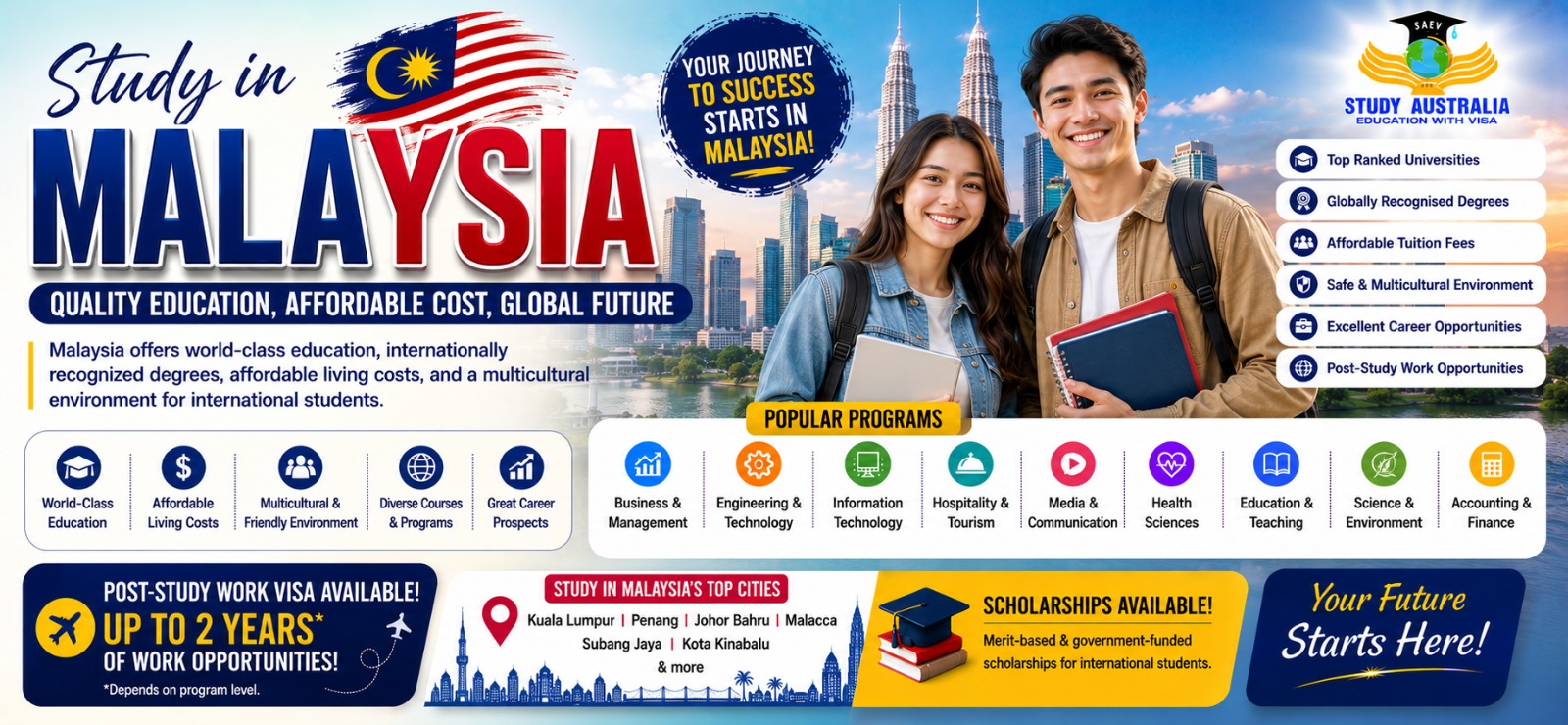
Malaysia has become one of Asia’s leading destinations for international education, offering globally recognised qualifications, affordable tuition fees, and a multicultural environment. Located in Southeast Asia, Malaysia is known for its modern cities, diverse culture, excellent infrastructure, and high standard of living. The country combines quality education with relatively low living costs, making it an attractive choice for students from around the world, including Bangladesh.
Malaysia is home to numerous public and private universities, international branch campuses, and specialised higher education institutions. Many internationally recognised universities from countries such as the United Kingdom and Australia have established branch campuses in Malaysia, allowing students to earn globally recognised degrees at a lower cost.
Each year, thousands of international students choose Malaysia because of its quality education, English-medium programmes, affordable tuition fees, and excellent career opportunities. The country offers a welcoming and multicultural environment where students from different nationalities can study together while experiencing a unique blend of Asian cultures.
Malaysia’s higher education system is regulated by the Ministry of Higher Education (MOHE), while the Malaysian Qualifications Agency (MQA) ensures that academic programmes meet national and international quality standards. Degrees awarded by accredited Malaysian universities are recognised in many countries around the world.
Why Study in Malaysia?
Malaysia offers many advantages for international students seeking quality higher education at an affordable cost. Some of the key reasons to choose Malaysia include:
- Internationally recognised universities and qualifications.
- Affordable tuition fees and living expenses compared to many other study destinations.
- English is widely used as the medium of instruction in higher education.
- Opportunities to study at international branch campuses of leading global universities.
- Safe, modern, and multicultural society.
- Excellent transportation and student-friendly infrastructure.
- Strong emphasis on research, innovation, and industry collaboration.
- Diverse range of undergraduate, postgraduate, and research programmes.
- Strategic location in Southeast Asia with convenient travel to neighbouring countries.
- Opportunities to gain international exposure through student exchange and transfer programmes.
Malaysia continues to strengthen its position as an international education hub by investing in higher education, research, innovation, and graduate employability. Students benefit from modern campuses, experienced academic staff, and qualifications that are valued by employers worldwide.
For Bangladeshi students seeking an affordable destination that offers high-quality education, internationally recognised degrees, and a multicultural learning environment, Malaysia remains one of the most attractive study destinations in Asia.
Malaysia Education System
Malaysia has a well-developed and internationally recognised higher education system that attracts students from around the world. The country’s education sector is regulated by the Ministry of Higher Education (MOHE), while academic quality and programme accreditation are overseen by the Malaysian Qualifications Agency (MQA). This ensures that universities maintain high educational standards and that qualifications are recognised both nationally and internationally.
Malaysia offers a wide range of higher education institutions, including public universities, private universities, university colleges, polytechnics, and international branch campuses of globally recognised universities.
Study Levels
The Malaysian education system consists of the following stages:
- Preschool Education
- Primary Education
- Secondary Education
- Pre-University Education
- Higher Education
Types of Higher Education Institutions
International students can study at various types of institutions, including:
- Public Universities
- Private Universities
- University Colleges
- Polytechnics
- Community Colleges
- International Branch Campuses
- Private Higher Education Institutions
Many universities also offer foundation programmes, diploma courses, English language programmes, and pathway courses for international students.
Qualifications Framework
Malaysia follows the Malaysian Qualifications Framework (MQF), which provides nationally recognised standards for higher education qualifications.
Common higher education qualifications include:
- Certificate
- Diploma
- Advanced Diploma
- Bachelor’s Degree
- Postgraduate Diploma
- Master’s Degree
- Doctor of Philosophy (PhD)
Qualifications awarded by accredited Malaysian institutions are widely recognised by employers and higher education institutions worldwide.
Quality Assurance System
The quality of higher education in Malaysia is monitored by the Malaysian Qualifications Agency (MQA). The MQA evaluates and accredits academic programmes to ensure they meet national quality standards. Universities are also subject to regular assessments to maintain academic excellence, research quality, and student support services.
Higher Education
Malaysia offers undergraduate, postgraduate, and research programmes across a wide range of disciplines, including:
- Business and Management
- Engineering
- Information Technology
- Artificial Intelligence
- Medicine and Health Sciences
- Hospitality and Tourism
- Accounting and Finance
- Architecture
- Law
- Education
- Science and Technology
- Creative Arts and Design
Most universities offer programmes taught entirely in English, making Malaysia an attractive destination for international students.
Undergraduate Courses
Undergraduate programmes combine academic knowledge with practical learning and industry experience to prepare students for professional careers.
| Programme | Typical Duration |
| Certificate | 1 year |
| Diploma | 2–3 years |
| Bachelor’s Degree | 3–4 years |
| Professional Degrees (Medicine, Dentistry, etc.) | 5–6 years |
Postgraduate Studies
Postgraduate programmes focus on advanced knowledge, research, and professional development.
| Programme | Typical Duration |
| Postgraduate Diploma | 6 months–1 year |
| Master’s Degree (Coursework or Research) | 1–2 years |
| Doctor of Philosophy (PhD) | 3–5 years |
Pathway Programmes
Many Malaysian universities provide pathway programmes for international students who need additional academic preparation or English language support before beginning a degree programme.
These may include:
- Foundation Programmes
- English Language Courses
- University Preparation Programmes
- Diploma-to-Degree Pathways
These programmes help students satisfy university entry requirements and successfully transition into undergraduate or postgraduate study.
Malaysia Fees for International Students
The cost of studying in Malaysia is relatively affordable compared to many other popular international study destinations. Tuition fees vary depending on the university, programme, level of study, and whether the institution is public or private. Public universities generally offer lower tuition fees, while private universities and international branch campuses may have higher fees.
Living expenses in Malaysia are also comparatively low, making it an attractive destination for Bangladeshi students seeking quality education at a reasonable cost.
Tuition Fees
The cost of tuition depends on the type of programme and institution. Professional programmes such as Medicine, Dentistry, and Engineering generally have higher tuition fees than Business, Arts, or Social Sciences.
| S. No. | Study Programme | Average Tuition Fee (MYR) |
| 1 | Undergraduate Bachelor’s Degree | MYR 20,000 – MYR 45,000 per year |
| 2 | Postgraduate Master’s Degree | MYR 15,000 – MYR 40,000 per year |
| 3 | Doctoral Degree (PhD) | MYR 18,000 – MYR 35,000 per year |
Please Note: Tuition fees are indicative and vary depending on the university, programme, and scholarship awarded.
Accommodation Cost
International students can choose from several accommodation options, including university hostels, private apartments, shared accommodation, and homestays.
University-managed accommodation is usually the most economical option and often includes internet access, security, laundry facilities, and common study areas.
When selecting accommodation, students should consider:
- Rental cost
- Location
- Transportation
- Utility bills
- Internet access
- Security
- Deposit requirements
- Tenancy agreement
Estimated Monthly Living Expenses
The cost of living depends on the city, accommodation type, and personal lifestyle. Kuala Lumpur and other major cities generally have slightly higher living expenses than smaller towns.
| Expense | Approximate Monthly Cost (MYR) |
| Accommodation | MYR 500 – MYR 1,500 |
| Food | MYR 500 – MYR 900 |
| Transportation | MYR 100 – MYR 250 |
| Internet & Mobile | MYR 80 – MYR 150 |
| Utilities | MYR 100 – MYR 250 |
| Personal Expenses | MYR 300 – MYR 600 |
Estimated Monthly Living Cost
Most international students spend approximately MYR 1,600 – MYR 3,500 per month, depending on their lifestyle, accommodation choice, and city of residence.
Students are encouraged to prepare a realistic budget before travelling to Malaysia and always verify the latest tuition fees and accommodation costs directly with their chosen university.
Scholarships to Study in Malaysia
Malaysia offers a variety of scholarships and financial assistance programmes for international students pursuing higher education. Scholarships are funded by the Malaysian Government, Malaysian universities, private organisations, and international institutions. Depending on the scholarship, financial support may cover tuition fees, living expenses, accommodation, travel costs, or a combination of these benefits.
Many scholarships are awarded based on academic excellence, while others consider leadership qualities, research potential, or financial need. Since scholarship opportunities vary by university and programme, Bangladeshi students are encouraged to check the official website of their chosen institution for the latest eligibility criteria and application deadlines.
Some of the most popular scholarship programmes available in Malaysia include:
| S. No. | Name of the Scholarship | Description |
| 1 | Malaysia International Scholarship (MIS) | Funded by the Government of Malaysia, the Malaysia International Scholarship supports outstanding international students pursuing postgraduate studies at selected Malaysian public and private universities. |
| 2 | MTCP Scholarship (Malaysian Technical Cooperation Programme) | Sponsored by the Government of Malaysia, this scholarship provides financial support to students from developing countries undertaking selected Master’s degree programmes in Malaysia. |
| 3 | University Scholarships | Many Malaysian universities offer merit-based and tuition fee scholarships for international students. Scholarship values and eligibility criteria vary depending on the institution and programme. |
| 4 | Research Scholarships | Selected universities provide scholarships, research grants, and assistantships for eligible Master’s and PhD students engaged in research-based programmes. |
| 5 | Faculty and Departmental Scholarships | Individual faculties and academic departments may offer scholarships or tuition discounts based on academic performance and outstanding achievement. |
Additional Financial Support
Apart from scholarships, international students may also benefit from:
- Tuition fee waivers offered by universities.
- Research grants for postgraduate students.
- Graduate assistantships and research assistant positions.
- Financial assistance from educational foundations and partner organisations.
Please Note: Scholarship availability, eligibility requirements, funding amounts, and application deadlines vary by university and academic year. Bangladeshi students are advised to begin searching for scholarships 8–12 months before their intended intake and always refer to the official university or scholarship provider’s website for the latest information.
Work and Study in Malaysia
International students in Malaysia are permitted to work part-time while studying, subject to the regulations of the Immigration Department of Malaysia and their student visa conditions. Part-time employment can help students gain work experience and assist with day-to-day living expenses. However, work should never interfere with academic commitments.
While Studying
Part-Time Work
International students are generally allowed to work:
- Up to 20 hours per week during semester breaks or official holidays of more than seven days.
- Employment is permitted only in approved sectors and with the necessary permission from the relevant Malaysian authorities.
Students may find part-time opportunities in:
- Restaurants and cafés
- Hotels and resorts
- Convenience stores and supermarkets
- Petrol stations
- Mini markets
- Other approved service sectors
International students are not permitted to work as cashiers, singers, masseurs, musicians, or in any occupation considered unsuitable under Malaysian immigration regulations.
After Graduation
Employment Opportunities
Students wishing to remain in Malaysia after graduation must obtain an appropriate employment pass or work visa sponsored by a Malaysian employer. Employment opportunities are available across various industries, depending on the graduate’s qualifications and skills.
Major employment sectors include:
- Information Technology (IT)
- Engineering
- Business and Finance
- Manufacturing
- Healthcare
- Hospitality and Tourism
- Education
- Logistics and Supply Chain
- Digital Marketing
- Artificial Intelligence and Data Science
Internship Opportunities
Many Malaysian universities include internships or industrial training as part of their academic programmes. These placements allow students to gain practical experience, develop professional skills, and build industry connections before graduation.
Important Requirements
International students who wish to work while studying should:
- Hold a valid Malaysian Student Pass.
- Comply with all student visa conditions.
- Obtain approval where required before commencing employment.
- Ensure that employment does not affect their academic performance.
- Follow all Malaysian immigration and labour regulations.
Failure to comply with these regulations may affect a student’s immigration status or future visa applications.
Please Note: Employment regulations, permitted working hours, and immigration policies may change. Bangladeshi students are advised to verify the latest requirements with the Immigration Department of Malaysia, Education Malaysia Global Services (EMGS), or their university’s international student office before accepting any employment.