
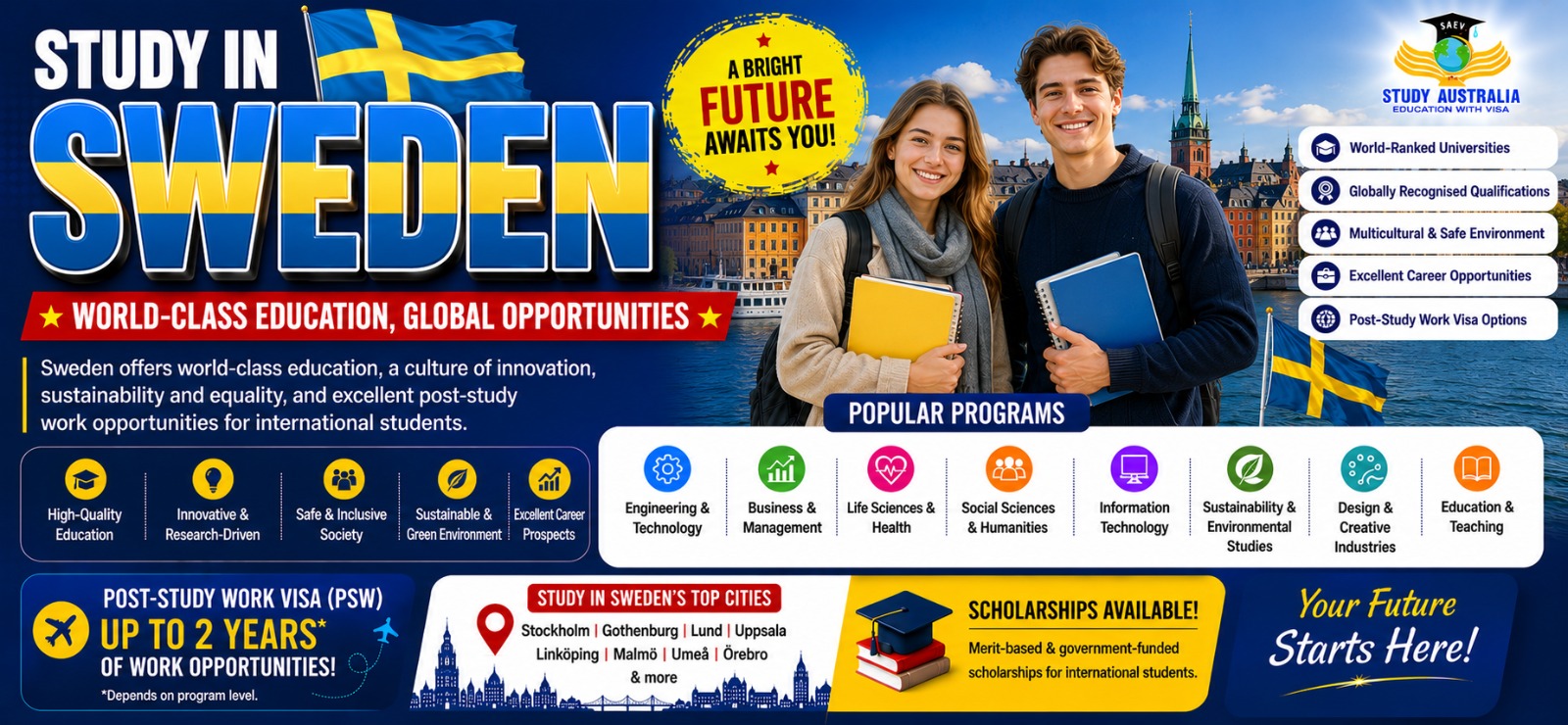
Sweden is one of Europe’s most innovative and student-friendly destinations for higher education. Located in Northern Europe, Sweden is known for its breathtaking natural landscapes, high standard of living, strong economy, and world-class education system. The country shares borders with Norway and Finland and is connected to Denmark via the Öresund Bridge. From vibrant cities such as Stockholm, Gothenburg, and Malmö to its beautiful forests, lakes, and the Northern Lights, Sweden offers an exceptional living and learning experience for international students.
Sweden has earned a global reputation for academic excellence, innovation, sustainability, and research. Its universities encourage critical thinking, creativity, teamwork, and practical learning rather than memorisation. Degrees awarded by Swedish universities are internationally recognised, making graduates highly competitive in the global job market.
Every year, thousands of international students choose Sweden because of its high-quality education, multicultural environment, and excellent career opportunities. Many universities offer a wide range of Bachelor’s and Master’s programmes taught entirely in English, making Sweden an attractive destination for students from Bangladesh and around the world.
Why Study in Sweden?
Sweden is home to several internationally recognised universities that consistently rank among the world’s best. The country places a strong emphasis on research, innovation, technology, sustainability, business, engineering, and life sciences. Students benefit from modern teaching methods, close collaboration with industry, and opportunities to participate in research projects during their studies.
One of Sweden’s greatest strengths is its focus on innovation and entrepreneurship. Many globally recognised companies, including IKEA, Volvo, Ericsson, Spotify, H&M, Scania, SKF, and AstraZeneca, originated or have major operations in Sweden, providing excellent internship and career opportunities for graduates.
Sweden is also recognised for its welcoming and inclusive society. International students enjoy a safe environment, excellent public services, efficient transportation, and a high quality of life. Universities actively support international students through orientation programmes, career services, student unions, and various academic support facilities.
For Bangladeshi students seeking a globally recognised qualification, practical learning experience, and strong career prospects, Sweden offers an outstanding study destination with excellent opportunities for both academic and personal development.
Sweden Education System
Sweden has one of the world’s most respected higher education systems, recognised for its emphasis on innovation, independent learning, research, and collaboration with industry. The Swedish education system encourages students to think critically, solve real-world problems, and develop practical skills alongside academic knowledge.
The Swedish Higher Education Authority (UKÄ) is responsible for monitoring the quality of higher education institutions and ensuring that universities maintain high academic standards.
Study Levels
Higher education in Sweden consists of three main cycles:
- First Cycle – Bachelor’s Degree
- Second Cycle – Master’s Degree
- Third Cycle – Doctoral (PhD) Degree
International students may also study pathway or foundation programmes where available to meet university entry requirements.
Qualifications Framework
Sweden follows the European Higher Education Area (EHEA) and the European Credit Transfer and Accumulation System (ECTS), making Swedish qualifications internationally recognised and easily transferable across Europe and many other countries.
Quality Assurance System
The quality of higher education in Sweden is supervised by the Swedish Higher Education Authority (UKÄ). The agency regularly evaluates universities and degree programmes to ensure they meet national and international academic standards. Swedish universities are also recognised globally for their strong research output and innovation.
Higher Education
Higher education in Sweden includes Bachelor’s, Master’s, and Doctoral programmes. Many universities also offer English-taught programmes, particularly at the Master’s level, making Sweden an attractive destination for international students.
Undergraduate Courses
Bachelor’s programmes combine theoretical knowledge with practical learning and usually include group projects, presentations, research assignments, and industry collaboration.
| Program | Duration |
| University Diploma | 2 years |
| Bachelor’s Degree | 3 years (180 ECTS Credits) |
| Professional Degree Programmes | 3–5.5 years (depending on the profession) |
Postgraduate Studies
Master’s programmes focus on advanced academic knowledge, research, and professional development. Students can choose between one-year and two-year Master’s degrees depending on their career goals.
| Program | Duration |
| Postgraduate Diploma/Certificate (where available) | Varies by institution |
| Master’s Degree (60 ECTS) | 1 year |
| Master’s Degree (120 ECTS) | 2 years |
| Doctoral (PhD) Degree | Approximately 4 years |
Pathway Programmes
Some universities and partner institutions offer pathway or foundation programmes for students who need to improve their academic qualifications or English language proficiency before beginning a full degree programme. These programmes help students transition successfully into university-level education in Sweden.
Sweden Fees for International Students
The cost of studying in Sweden depends on several factors, including the university, study programme, and city where you choose to live. Tuition fees vary between institutions, while living expenses depend largely on your lifestyle and location. Cities such as Stockholm, Gothenburg, and Malmö generally have a higher cost of living than smaller towns.
For international students from Bangladesh, it is important to budget for tuition fees as well as accommodation, food, transportation, insurance, and other personal expenses before beginning your studies.
Tuition Fees
Tuition fees vary depending on the university and programme. Courses in engineering, medicine, architecture, and business are generally more expensive than programmes in humanities or social sciences.
| S. No. | Study Program | Average Tuition Fee (SEK) |
| 1 | Bachelor’s Degree | SEK 80,000 – SEK 180,000 per year |
| 2 | Master’s Degree | SEK 80,000 – SEK 295,000 per year |
| 3 | Doctoral (PhD) Degree | Usually tuition-free for admitted PhD candidates* |
*Please Note: Most PhD positions at Swedish public universities are fully funded, and doctoral students are often employed by the university while conducting their research.
Accommodation Cost
Accommodation is usually the largest living expense for students in Sweden. Universities may assist international students in finding housing, although availability is limited and cannot always be guaranteed. Students can choose from university housing, student residences, shared apartments, or private rentals.
Before renting accommodation, students should consider:
- Monthly rent
- Deposit requirements
- Location and transport
- Internet and utility costs
- Lease agreement
- Furniture availability
- House rules
Estimated Monthly Living Costs
| Expense | Estimated Cost (SEK) |
| Accommodation | 3,500 – 7,500 |
| Food | 2,500 – 3,500 |
| Transportation | 600 – 1,000 |
| Internet & Mobile | 300 – 600 |
| Books & Study Materials | 500 – 1,000 |
| Personal Expenses | 1,000 – 2,000 |
| Estimated Monthly Total | 8,000 – 13,000 SEK |
The Swedish Migration Agency currently recommends that international students demonstrate sufficient funds to cover their living expenses while studying in Sweden. Students should always check the latest financial requirement before applying for their residence permit.
Please Note: Tuition fees and living costs are approximate and may vary depending on the university, programme, city, and individual lifestyle. Students should always refer to their chosen university for the most up-to-date fee information.
Scholarships to Study in Sweden
There are a number of scholarships and financial assistance programmes available for students who wish to study in Sweden. Scholarships are offered by the Swedish Government, Swedish universities, private organisations, and international programmes. Depending on the scholarship, students may receive support towards tuition fees, living expenses, travel costs, or a combination of these benefits.
Bangladeshi students can apply for both government-funded and university-funded scholarships. Since government scholarships are highly competitive, students are encouraged to begin the application process 8–12 months before their preferred intake. It is also recommended to check the official website of the university to learn about scholarships available for their chosen programme.
Here are some of the most popular scholarship programmes available for Bangladeshi students:
| S. No. | Name of the Scholarship | Description |
| 1 | Swedish Institute Scholarships for Global Professionals (SISGP) | This prestigious scholarship is funded by the Swedish Institute and is available for eligible international students, including applicants from Bangladesh, applying for selected Master’s programmes. It covers tuition fees, living expenses, insurance, and a travel grant where applicable. |
| 2 | University Scholarships | Many Swedish universities offer merit-based scholarships to international students. Depending on the university, these scholarships may cover partial or full tuition fees. |
| 3 | Erasmus+ Programme | Erasmus+ provides financial assistance to eligible students participating in exchange programmes or joint Master’s programmes between European universities. The scholarship may include tuition support, travel expenses, and a monthly allowance. |
| 4 | Visby Programme Scholarships | The Swedish Institute offers Visby Programme Scholarships for selected countries and academic programmes. Eligibility depends on the applicant’s nationality and chosen field of study. |
| 5 | Private Foundation Scholarships | Several Swedish foundations and organisations provide scholarships and research grants for international students studying at Swedish universities. |
This is an indicative list. Bangladeshi students are advised to consult their education counsellor or visit the official university and scholarship websites to find the most suitable funding opportunities.
Most Swedish universities also offer their own scholarships for international students based on academic performance and programme eligibility.
Work and Study in Sweden
International students in Sweden are allowed to work while studying, and there is no official limit on the number of hours they can work. However, students are expected to ensure that their employment does not negatively affect their academic progress. Many students take up part-time jobs to help cover living expenses and gain valuable work experience.
Internships are also available in many academic programmes, allowing students to develop practical skills and build professional networks that may improve their career prospects after graduation.
While Studying:
Part-Time: No official hourly limit, provided it does not affect your studies.
Full-Time: Students may also work full-time during semester breaks and holidays, subject to employer requirements.
After Graduation:
International students who complete a higher education qualification in Sweden may apply for a residence permit to look for work or start a business after graduation.
This residence permit is generally granted for up to 12 months, allowing graduates sufficient time to find suitable employment or establish their own business in Sweden.
Residence Permit After Studies
Graduates who wish to remain in Sweden after completing their studies must apply for a residence permit before their current student permit expires.
To be eligible, students generally need to:
- Have successfully completed their studies at a Swedish higher education institution.
- Hold a valid passport.
- Be able to financially support themselves during the permit period.
- Apply before their existing residence permit expires.
Once a graduate secures a qualifying job that meets the requirements of the Swedish Migration Agency, they may apply for a work permit and continue living and working in Sweden.
For the latest rules regarding post-study residence permits and work rights, students should refer to the official website of the Swedish Migration Agency (Migrationsverket).