
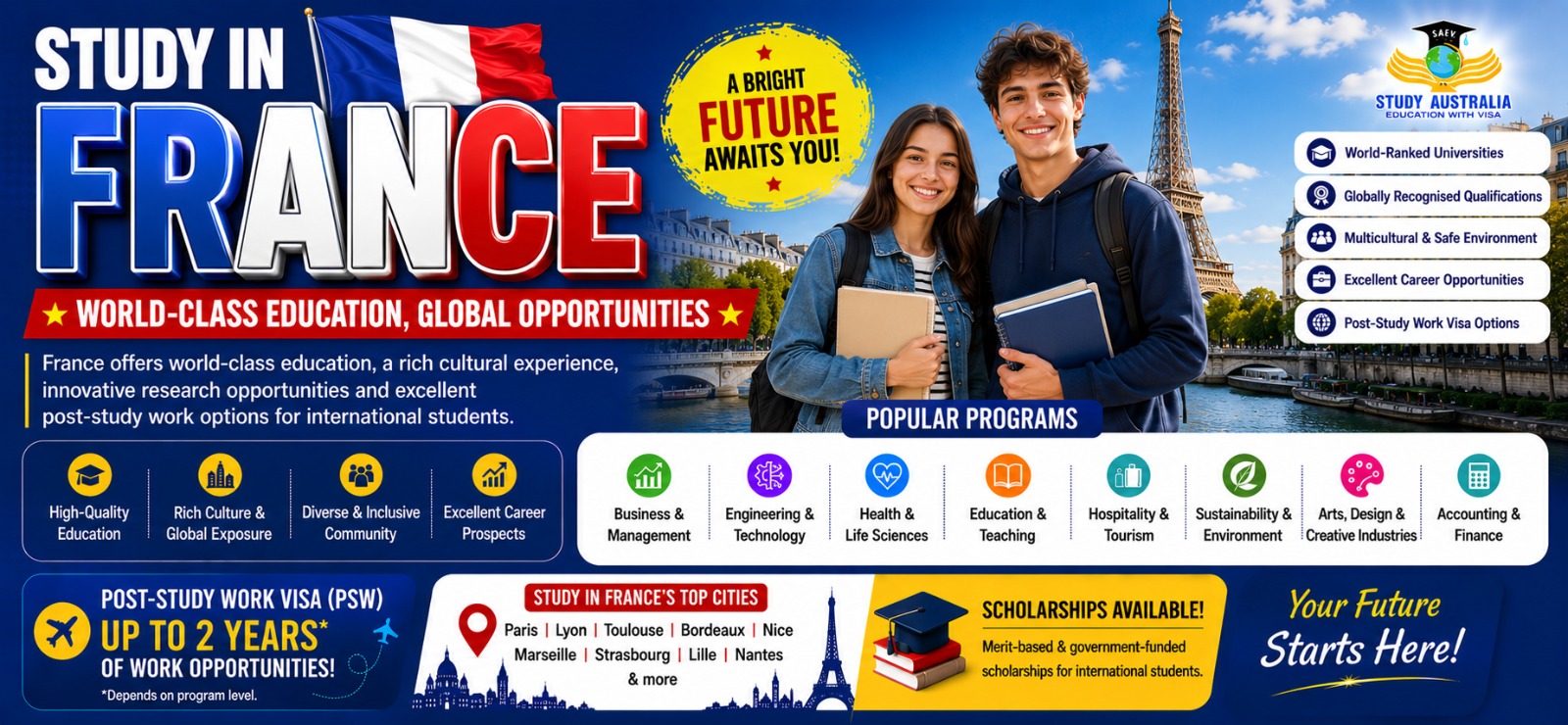
France is one of Europe’s most attractive destinations for international education, offering a unique combination of academic excellence, cultural heritage, and modern innovation. Situated in Western Europe, the country stretches from the Mediterranean Sea to the English Channel and the North Sea, providing diverse landscapes ranging from beautiful coastlines and countryside to the majestic Alps and Pyrenees.
France is internationally recognised for its contributions to art, science, philosophy, fashion, literature, and gastronomy. With centuries of academic tradition and a strong commitment to research and innovation, it continues to attract students from around the globe. Some of France’s most famous landmarks include the Eiffel Tower in Paris, the Palace of Versailles, Mont Saint-Michel in Normandy, the French Riviera (Côte d’Azur), the Louvre Museum, and Mont Blanc, the highest mountain in Western Europe.
For Bangladeshi students seeking a globally recognised qualification in a culturally rich environment, France offers an excellent study destination. The country welcomes more than 400,000 international students each year, making it one of the world’s leading destinations for higher education. International students represent a significant proportion of enrolments at French universities, particularly in Master’s and Doctoral programmes.
France provides an outstanding academic environment supported by world-class universities, specialised institutions, and internationally respected Grandes Écoles. Students benefit from high-quality teaching, cutting-edge research, practical learning opportunities, and strong links between universities and industry. France has developed one of the world’s most respected and accessible higher education systems, offering internationally recognised qualifications across a wide range of disciplines.
French higher education institutions consistently perform well in prestigious global university rankings, including the QS World University Rankings, Times Higher Education World University Rankings, Academic Ranking of World Universities (Shanghai Ranking), Financial Times Rankings, and U-Multirank. The country’s strong reputation is also reflected in its remarkable achievements in research and innovation. France has produced numerous Nobel Prize winners and Fields Medal recipients, demonstrating its long-standing contribution to scientific discovery and academic excellence.
Why Study in France!
Study in France in English
France offers an increasing number of Bachelor’s and Master’s degree programmes taught entirely in English, making it an attractive option for international students who may not yet speak French. Many universities conduct lectures, assignments, projects, and examinations in English for these programmes. However, learning basic French is highly recommended, as it can make daily life easier and significantly improve employment opportunities during and after graduation.
Admission Requirements
Admission requirements vary depending on the university and the chosen programme. In general, international students must receive an admission offer from a recognised French higher education institution before applying for a student visa. Applicants may also be required to demonstrate English or French language proficiency, depending on the language of instruction. As each institution sets its own entry requirements, students should carefully review the official admission criteria for their selected programme before applying.
Study in France Without IELTS
Although IELTS is commonly accepted for English-taught programmes, it is not always mandatory. Several French universities may consider alternative proof of English proficiency, such as a Medium of Instruction (MOI) certificate, previous education completed in English, or an online interview conducted by the university. Admission policies differ between institutions, so applicants should confirm the accepted English language requirements directly with their chosen university.
Excellent Career Opportunities
France is home to many globally recognised companies and multinational organisations, creating excellent career prospects for graduates. Leading employers include Airbus, L’Oréal, Renault Group, Orange, Capgemini, Dassault Systèmes, Schneider Electric, TotalEnergies, and many others across industries such as engineering, technology, business, luxury goods, finance, healthcare, and renewable energy. Graduating from a French university can open doors to employment opportunities both within France and internationally.
- After nursery school or kindergarten (école maternelle), which is optional, the French compulsory education system is divided into three stages or ‘cycles’:
- primary school (école)
- middle school (collège)
- high school (lycée)
- Preschool/nursery (école maternelle)Preschools or nursery schools – écoles maternelles – provide care for children from two and three years old until they are six.
- Primary school (ecole primaire)Children in France attend primary school from the age of six to 11 years old. There are five levels:
- Cours préparatoire (CP) or 11ème – age 6 to 7 years old
- Cours élémentaire (CE1) or 10ème – age 7 to 8 years old
- Cours élémentaire (CE2) or 9ème – age 8 to 9 years old
- Cours moyen 1 (CM1) or 8ème – 9 to 10 years old
- Cours moyen 2 (CM2) or 7ème – 10 to 11 years old
- Middle school (collège)Between the ages of 11 and 15, students in France attend a middle school or collège. All pupils are accepted; there is no entrance exam or requirements for state schools. There are four levels:
- 6ème – 11 to 12 years old
- 5ème – 12 to 13 years old
- 4ème – 13 to 14 years old
- 3ème – 14 to 15 years old
- High school or lycéeThe last three years of secondary education – from 15 to 18 years old – are spent at a lycée general, a lycée technique or a lycée professionnel. Students take the same core curriculum of some eight or nine subjects but are offered three electives and an artistic workshop. At the end of this year, the key decision is made as to which baccalaureat the student will pursue. Lycée general and lycée technique . The levels are:
- Seconde (CAP, BEP) – 15 to 16 years old
- Première (CAP, BEP) – 16 to 17 years old
- Terminale (BAC) – 17 to 18 years old
- The Ministry of Educationand the Ministry of Higher Education and Research are responsible for determining the equivalency status of foreign applicants to public institutions. All the documents must be translated into French by a certified translator. When you apply to a French institution, you must include this attestation as part of your dossier.
France Fees for International Students
France uses the Euro (€) as its official currency. The cost of studying in France depends on the type of institution, programme, and level of study. Public universities in France are heavily subsidised by the French government, making them one of the most affordable higher education systems in Europe. Tuition fees at public universities are generally much lower than those at private institutions.
For international students from Bangladesh (non-EU/EEA countries), tuition fees at public universities are generally higher than those for French and EU students, although many universities provide scholarships or partial tuition fee waivers. Private universities and specialised institutions usually have their own fee structures and may charge significantly higher tuition fees.
The cost of living varies depending on the city. Paris is generally the most expensive, while cities such as Lille, Nantes, Grenoble, Dijon, and Clermont-Ferrand are comparatively more affordable. On average, students should budget between EUR 800 and EUR 1,500 per month to cover accommodation, food, transportation, insurance, and personal expenses.
Studying in France allows students to receive a globally recognised qualification while benefiting from government-supported higher education, excellent research facilities, and internationally respected universities.
Cost of Study in France According to Course and Degree
| Level of Degree | Course Type | Average Tuition Fees (EUR/Year) |
| Bachelor’s | Business & Management | 3,000 – 12,000 |
| Bachelor’s | Fashion, Architecture & Arts | 5,000 – 15,000 |
| Bachelor’s | Film, Media & Photography | 6,000 – 15,000 |
| Master’s | Business & Management | 4,000 – 18,000 |
| Master’s | Fashion, Architecture & Arts | 5,000 – 18,000 |
| Master’s | Film, Media & Photography | 8,000 – 20,000 |
| Bachelor’s / Master’s | Engineering | 3,000 – 15,000 |
* Tuition fees are indicative only and may vary depending on the university and programme.
Application and Document Fees
| Title | Estimated Fees |
| University Application Fee | EUR 50 – 300 (if applicable) |
| Campus France Bangladesh Processing Fee | As per the latest Campus France Bangladesh charges |
| France Visa Application Centre (VFS) Service Fee | As per the current VFS Global fee schedule |
| Student Visa Fee | As determined by the French Government |
| Documentation / Translation / Courier Charges | Varies depending on individual requirements |
* All fees are subject to change without prior notice. Applicants should verify the latest charges before applying.
Living Cost in France
| Type | Approximate Cost (EUR/Month) |
| Student Accommodation / One-bedroom Apartment | 400 – 900 |
| Utilities (Electricity, Water, Heating, etc.) | 80 – 180 |
| Public Transport Pass | 30 – 80 |
| Mobile Phone & Internet | 20 – 40 |
| Food & Groceries | 200 – 350 |
| Recreation & Entertainment | 80 – 150 |
| Health & Personal Expenses | 70 – 120 |
| Estimated Monthly Living Cost | 800 – 1,500 |
* The above costs are approximate and may vary depending on the city, accommodation type, and personal lifestyle. Paris generally has higher living expenses than other French cities.
Scholarships to Study in France
There are also certain scholarships and mobility schemes available for those who wish to study abroad in France. Some of the most popular ones include grants from the French Ministry of Higher Education and Research, funding made by the National Centre for Scientific Research (CNRS), awards from regional councils, Erasmus and Erasmus Mundus programs. To attract a large number of international students, the government of France and universities as well have introduced a large number of scholarships to help students with their expenses in France. The scholarship can be need based, to the students who are not that financially solid, or merit-based, for the students with extraordinary academic record. It is better to check with the university one is applying to, to understand what all scholarships he or she is eligible for.
Apart from the waiver in tuition fees, some scholarships also help students with the living/other costs in France. The French government and universities provide various scholarships to Bangladeshi students to help them during their studies. There are lots of scholarships available in France, but CAF is one of the most valuable forms of financial support for international students. In France, the Government offers significant support to eligible students by providing housing assistance to help pay their rent. The amount of assistance varies depending on the type of accommodation and the student’s financial circumstances.
PSW VISA in France
International students in France are permitted to work part-time while pursuing their studies. However, employment should not interfere with academic commitments. Students can work up to 20 hours per week during the academic session, allowing them to earn extra income to help cover living expenses. During semester breaks and official holidays, students are generally allowed to work full-time. Many students also take advantage of internships, which are included in many academic programmes, to gain practical industry experience and build professional networks before graduation.
While Studying
Part-Time: Up to 20 hours per week during the academic session.
Full-Time: Up to 40 hours per week during semester breaks and official holidays.
After Graduation
International graduates may be eligible to remain in France after completing their studies to search for employment or start a business, subject to the immigration rules in force at the time.
TEMPORARY RESIDENCE PERMIT (APS)
WHAT DOES THE TEMPORARY RESIDENCE PERMIT (APS) ALLOW?
The Autorisation Provisoire de Séjour (APS) is a temporary residence permit that allows eligible international graduates to remain in France after completing their studies. During this period, graduates may look for employment or prepare to establish a business related to their field of study.
Until they obtain a fixed-term (CDD) or permanent (CDI) employment contract, APS holders are generally permitted to work under the same conditions that applied during their student status, subject to the applicable working hour limits.
Non-European Students
To remain in France after graduation, non-European students generally need to secure a job offer or employment contract that meets the salary requirements established by the French Government. Graduates who have not yet secured employment may be eligible to apply for an Autorisation Provisoire de Séjour (APS), allowing them to stay in France temporarily while searching for employment or preparing to launch a business. Eligibility requirements depend on the qualification obtained and the immigration regulations in force at the time of application.
For the latest visa and post-study work regulations, students should consult the official website of the French Ministry of the Interior or contact the nearest Campus France office for up-to-date guidance.