
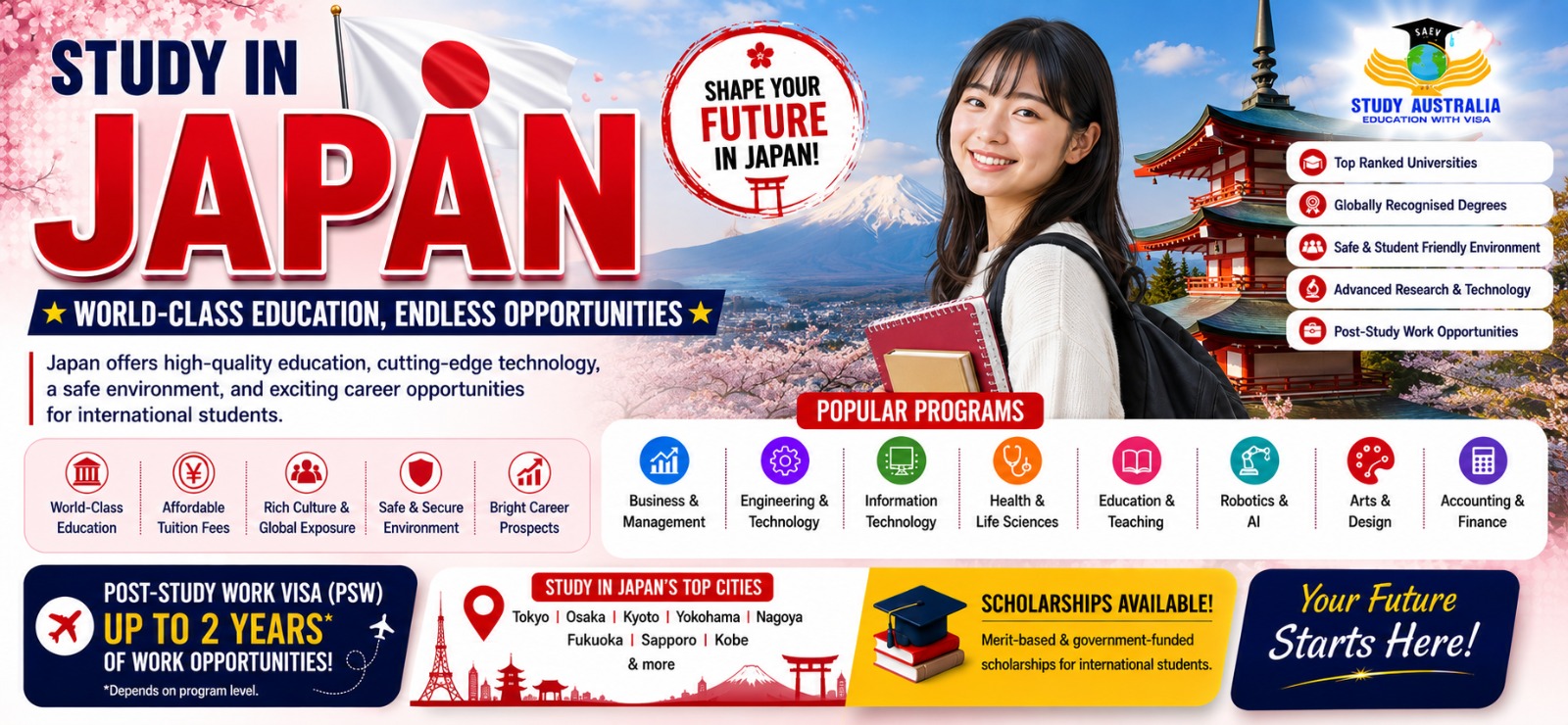
Japan is one of Asia’s leading education destinations, renowned for its world-class universities, cutting-edge technology, rich cultural heritage, and safe living environment. Located in East Asia, Japan consists of four main islands—Honshu, Hokkaido, Kyushu, and Shikoku—along with thousands of smaller islands. The country successfully blends centuries-old traditions with modern innovation, making it an attractive destination for international students from around the world.
Japan is internationally recognised for excellence in engineering, robotics, information technology, business, medicine, environmental science, and research. Home to globally respected universities and advanced research institutions, Japan provides students with high-quality education, state-of-the-art facilities, and strong industry connections.
Each year, thousands of international students choose Japan because of its outstanding academic standards, affordable tuition fees compared to many Western countries, excellent scholarship opportunities, and welcoming environment. Many universities now offer undergraduate and postgraduate programmes taught entirely in English, allowing students to study without requiring advanced Japanese language skills. However, learning basic Japanese is highly recommended, as it helps students adapt to daily life and improves future employment opportunities.
Japan is also home to many globally recognised companies such as Toyota, Sony, Panasonic, Honda, Mitsubishi, Canon, Nissan, Hitachi, Fujitsu, and SoftBank, providing excellent internship and career opportunities for graduates.
Why Study in Japan?
Japan has become one of the most preferred study destinations for international students due to its excellent education system, technological advancement, and strong employment prospects. Degrees awarded by Japanese universities are recognised worldwide and are highly valued by employers across different industries.
Some of the major reasons to choose Japan include:
- Globally recognised universities and qualifications.
- High-quality teaching and research facilities.
- Affordable tuition fees compared to many other developed countries.
- Wide range of English-taught Bachelor’s, Master’s, and PhD programmes.
- Generous government and university scholarships.
- Safe, clean, and modern living environment.
- Strong emphasis on innovation, science, and technology.
- Excellent internship and graduate employment opportunities.
- Opportunity to experience Japan’s unique culture and traditions.
- Access to one of the world’s largest and most advanced economies.
Japan offers students the chance to gain internationally respected qualifications while developing valuable academic, professional, and intercultural skills in a globally competitive environment.
Japan Education System
Japan is internationally recognised for its high academic standards, innovative teaching methods, and strong emphasis on research and practical learning. The country’s higher education system is regulated by the Ministry of Education, Culture, Sports, Science and Technology (MEXT), which ensures that universities and colleges maintain high educational standards.
Japan has more than 800 universities, including national, public, and private institutions, offering a wide variety of undergraduate, postgraduate, and research programmes. Many universities also provide English-taught degree programmes specifically designed for international students.
Study Levels
The education system in Japan consists of the following stages:
- Elementary Education
- Lower Secondary Education
- Upper Secondary Education
- Higher Education
Types of Higher Education Institutions
Japan’s higher education system includes several types of institutions:
- National Universities
- Public Universities
- Private Universities
- Junior Colleges
- Colleges of Technology (KOSEN)
- Professional Training Colleges (Specialised Training Colleges)
Quality Assurance System
The quality of higher education in Japan is maintained through accreditation and evaluation systems recognised by MEXT. Universities are periodically assessed by certified accreditation agencies to ensure they continue to meet national academic standards and provide high-quality education and research opportunities.
Higher Education
Higher education in Japan includes undergraduate, master’s, doctoral, and professional degree programmes. International students may also enrol in Japanese language programmes or foundation/pathway courses before commencing their degree if they need additional academic or language preparation.
Undergraduate Courses
Japanese universities offer undergraduate programmes across a wide range of disciplines, including engineering, business, computer science, information technology, medicine, social sciences, humanities, arts, agriculture, environmental science, and many others.
| Program | Duration |
| Associate Degree (Junior College) | 2 to 3 years |
| Professional Training College Diploma | 2 to 4 years |
| Bachelor’s Degree | 4 years (Most programmes) |
| Medicine, Dentistry & Veterinary Medicine | 6 years |
Postgraduate Studies
Japan offers internationally recognised postgraduate programmes with strong research opportunities and close collaboration between universities and industry.
| Program | Duration |
| Master’s Degree | 2 years |
| Doctoral (PhD) Degree | 3 to 5 years |
| Professional Degree Programmes | 2 to 3 years (depending on the field) |
Pathway Programmes
Students who do not meet the direct entry requirements or require additional Japanese or English language preparation may enrol in pathway programmes. These include foundation courses, preparatory education, and Japanese language programmes offered by universities and specialised institutions. These programmes help students develop the academic and language skills required for successful university studies in Japan.
Japan Fees for International Students
The cost of studying in Japan depends on several factors, including the university, programme, location, and whether the institution is public or private. Compared to many other popular study destinations, Japan offers excellent value for money while maintaining a high standard of education.
Public universities generally have lower tuition fees because they receive government support, while private universities may charge higher fees depending on the course and institution. Programmes such as medicine, dentistry, and business are often more expensive than humanities or social sciences.
Tuition Fees
The tuition fees for international students vary according to the level of study and the institution.
| S. No. | Study Programme | Average Tuition Fee (JPY) |
| 1 | Undergraduate Bachelor’s Degree | JPY 535,800 – JPY 1,500,000 per year |
| 2 | Postgraduate Master’s Degree | JPY 535,800 – JPY 1,500,000 per year |
| 3 | Doctoral (PhD) Degree | JPY 535,800 – JPY 1,500,000 per year |
Please note: The above figures are indicative. Tuition fees vary depending on the university, programme, and whether the institution is public or private.
Accommodation Cost
International students can choose from university dormitories, private apartments, shared accommodation, or homestays. University dormitories are generally the most affordable option, especially during the first year of study.
Accommodation costs vary depending on the city. Living in Tokyo and Osaka is generally more expensive than living in smaller cities.
When searching for accommodation, students should consider:
- Rent
- Security deposit
- Utility bills
- Internet charges
- Transportation
- Furniture and facilities
- Lease agreement
- House rules
Living Expenses
Apart from tuition fees, students should budget for accommodation, food, transportation, health insurance, communication, books, and personal expenses.
| Expense | Estimated Monthly Cost (JPY) |
| Accommodation | JPY 30,000 – JPY 80,000 |
| Food | JPY 25,000 – JPY 45,000 |
| Transportation | JPY 5,000 – JPY 15,000 |
| Utilities & Internet | JPY 8,000 – JPY 15,000 |
| Health Insurance & Personal Expenses | JPY 10,000 – JPY 20,000 |
| Estimated Monthly Living Cost | JPY 80,000 – JPY 150,000 |
The actual cost of living depends on the student’s lifestyle and the city where they choose to study. Students living in metropolitan areas such as Tokyo may require a higher monthly budget than those studying in regional cities.
Please Note: Tuition fees and living costs are approximate and may change depending on the university, location, exchange rates, and individual spending habits. Bangladeshi students should always refer to their chosen university for the latest fee information before applying.
Scholarships to Study in Japan
Japan offers a wide range of scholarships and financial assistance programmes for international students. These scholarships are funded by the Japanese Government (MEXT), universities, private foundations, and international organisations. Depending on the scholarship programme, financial support may cover tuition fees, monthly living expenses, travel costs, or a combination of these benefits.
Many scholarships are awarded based on academic excellence, while others consider research potential, financial need, or the applicant’s field of study. Bangladeshi students are encouraged to begin searching for scholarships 8–12 months before their intended intake and check the official website of their chosen university for the latest eligibility requirements and application deadlines.
| S. No. | Name of the Scholarship | Description |
| 1 | MEXT (Japanese Government) Scholarship | Offered by the Ministry of Education, Culture, Sports, Science and Technology (MEXT), this fully funded scholarship supports undergraduate, master’s, doctoral, and research students. It generally covers tuition fees, a monthly living allowance, and round-trip airfare. |
| 2 | JASSO Scholarship | The Japan Student Services Organization (JASSO) provides financial assistance to eligible international students studying at Japanese universities. The scholarship usually offers a monthly stipend to help with living expenses. |
| 3 | University Scholarships | Many national, public, and private universities in Japan offer merit-based scholarships, tuition fee reductions, or full and partial tuition waivers for outstanding international students. |
| 4 | Local Government and Foundation Scholarships | Various local governments, private foundations, and charitable organisations in Japan provide scholarships for eligible international students based on academic performance or financial need. |
| 5 | Research Scholarships | Research students enrolled in Master’s or PhD programmes may receive scholarships or research grants from universities, government agencies, or research institutions depending on their academic discipline and research project. |
Please Note: Scholarship availability, eligibility criteria, award amounts, and application deadlines vary by institution and academic year. Bangladeshi students are strongly advised to verify the latest scholarship information through the official website of their chosen university or scholarship provider before submitting an application.
Work and Study in Japan
International students in Japan are allowed to work part-time while studying, provided they obtain permission from the immigration authorities. Part-time employment allows students to gain practical experience, improve their Japanese language skills, and help cover their living expenses. Students should ensure that work commitments do not interfere with their academic studies.
While Studying
Part-Time Work
International students who hold a valid student visa and obtain Permission to Engage in Activity Other Than That Permitted by the Status of Residence may generally work:
- Up to 28 hours per week during academic sessions.
- Up to 40 hours per week (or 8 hours per day) during official university holidays and long vacation periods.
Many students find part-time employment in restaurants, convenience stores, supermarkets, hotels, offices, warehouses, language centres, and other service industries.
Working while studying enables students to:
- Gain valuable work experience.
- Improve Japanese language and communication skills.
- Build professional networks.
- Help manage day-to-day living expenses.
Some degree programmes also include internships or practical training opportunities that provide valuable industry experience.
After Graduation
International students who wish to remain in Japan after completing their studies must change their residence status to an appropriate work visa after securing employment with a Japanese employer.
Graduates who receive a job offer related to their qualifications may apply for a work visa under the relevant immigration category. Japan offers various work visa categories depending on the profession, including engineering, information technology, business, education, research, healthcare, and other specialised fields.
Students planning to stay in Japan after graduation should consult their university’s international office or the Immigration Services Agency of Japan for the latest visa requirements.
Documents Commonly Required for Employment
Students may be asked to provide the following documents when applying for part-time employment:
- Valid passport
- Valid Residence Card
- Student ID card or Certificate of Enrolment
- Permission to Engage in Activity Other Than That Permitted by the Status of Residence
- Employment contract (if applicable)
- My Number (Individual Number) for tax purposes
Please Note: Employment regulations, permitted working hours, visa conditions, and post-study work requirements may change. Bangladeshi students should always check the latest information with the Immigration Services Agency of Japan and their university before accepting employment.