
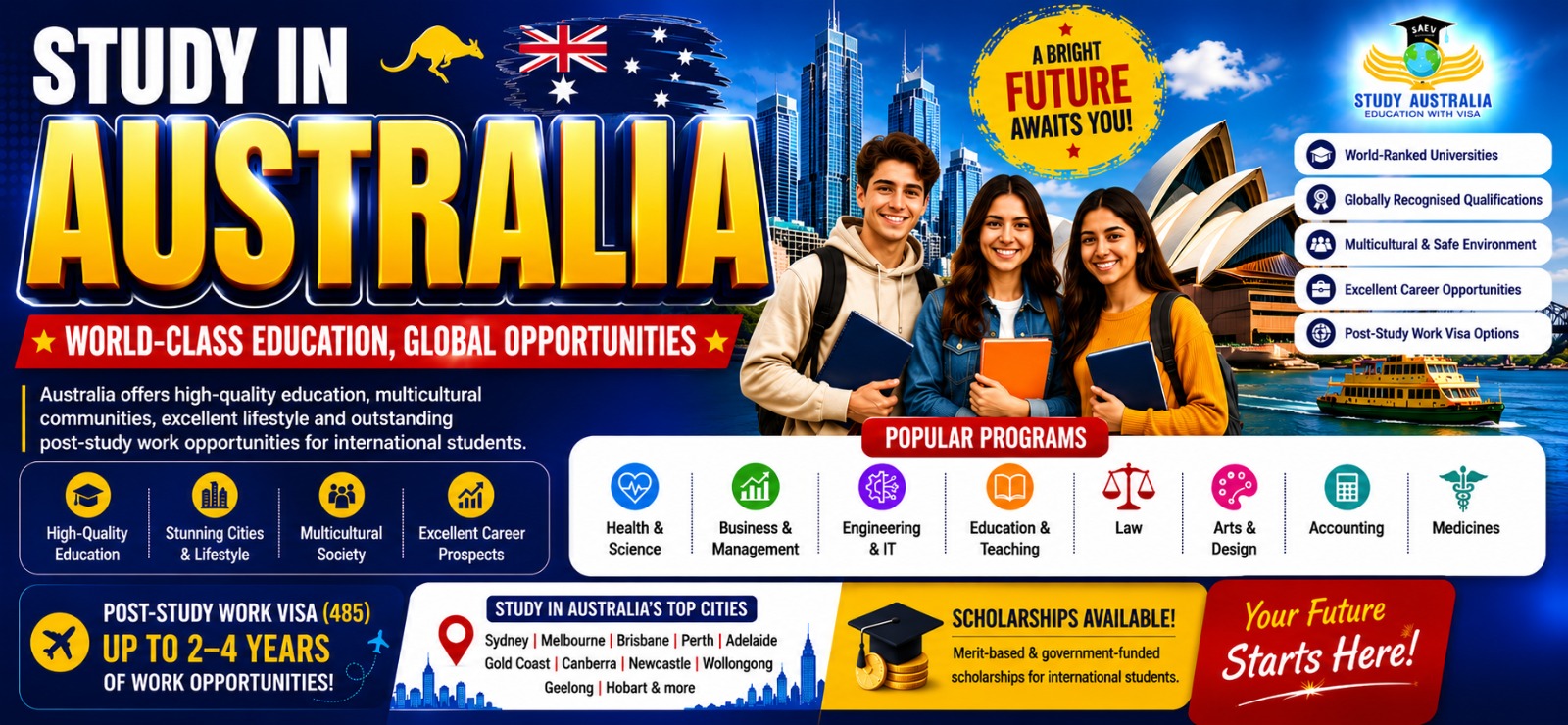
Study in Australia
Australia is one of the world’s most attractive destinations for international students, offering a combination of high-quality education, cultural diversity, and an outstanding lifestyle. Located in the Southern Hemisphere, Australia is the sixth-largest country in the world, covering approximately 7.7 million square kilometres. The country is internationally recognised for its beautiful beaches, unique wildlife, pleasant climate, and modern cities.
With a population of more than 27 million people, Australia is a multicultural nation where people from different backgrounds live, work, and study together. Its rich heritage is shaped by the traditions of Aboriginal and Torres Strait Islander peoples, alongside the contributions of communities from around the world. This cultural diversity creates a welcoming and inclusive environment for international students. More than 260 languages are spoken across Australian households, reflecting the country’s global outlook and multicultural character.
Australia is also recognised as a leading destination for education, attracting students from every corner of the world. The country’s globally respected institutions, innovative teaching methods, and strong focus on student success make it an excellent place to pursue academic and professional goals.
In addition to its educational excellence, Australia offers a remarkable natural environment. From tropical rainforests and stunning coastlines to mountain ranges and vast deserts, the country is home to a wide variety of landscapes and ecosystems. Alongside these natural attractions are vibrant cities such as Sydney, Melbourne, Brisbane, Perth, and Adelaide, which provide modern infrastructure, entertainment, cultural experiences, and excellent student facilities. Whether you enjoy city living or exploring nature, Australia offers the perfect balance between academic achievement and an exceptional quality of life.
Why Study in Australia?
Australia is recognised globally as one of the leading destinations for higher education. The country has built a strong reputation for academic excellence, innovation, and research, making it a preferred choice for international students. Australia consistently records high literacy rates and is home to a highly educated population, reflecting its commitment to quality education.
The Australian education system is known for maintaining rigorous academic standards while offering students access to modern facilities, industry-focused learning, and internationally recognised qualifications. Students can choose from a wide range of universities, colleges, and specialised institutions that provide programs across various fields of study.
Australian universities regularly feature in prestigious global rankings, demonstrating their commitment to teaching excellence, research achievements, and graduate employability. Institutions such as the Australian National University, the University of Melbourne, and the University of Sydney have earned international recognition for their academic performance and contribution to global research.
Today, Australia attracts thousands of international students every year, including a growing number of students from Bangladesh. The combination of world-class education, multicultural communities, excellent living standards, and attractive post-study opportunities makes Australia an ideal destination for pursuing higher education. Regardless of your chosen field of study, you will benefit from a supportive learning environment, experienced academic staff, and qualifications that are valued worldwide.
Australian Education System
Australia’s education system is highly respected for its academic quality, practical learning approach, and strong industry connections. Universities and educational institutions across the country are known for delivering innovative teaching methods and conducting world-class research, helping students develop the knowledge and skills required in today’s global workforce.
Australian institutions focus not only on academic achievement but also on building essential skills such as critical thinking, creativity, communication, problem-solving, ethical awareness, and analytical reasoning. This balanced approach ensures that graduates are well-prepared for professional success and lifelong learning.
The quality of education, modern campus facilities, experienced educators, and strong student support services are among the key reasons Australian universities consistently perform well in international rankings such as the QS World University Rankings and Times Higher Education Rankings.
Australian Qualifications Framework (AQF)
One of the key strengths of the Australian education system is the Australian Qualifications Framework (AQF). Introduced as Australia’s national qualifications policy, the AQF provides a unified framework that connects school education, vocational education and training (VET), and higher education qualifications.
The AQF establishes nationally recognised standards for qualifications across Australia, ensuring consistency, quality, and international recognition. As qualifications are regulated under this framework, students can be confident that their studies meet government-approved standards.
The AQF consists of 10 qualification levels that create clear pathways between different stages of education. This structure allows students to progress from certificates and diplomas to bachelor’s, master’s, and doctoral degrees while providing flexibility and opportunities for academic and career advancement. Students can move between study levels and institutions, subject to meeting academic and visa requirements.
Source: https://www.aqf.edu.au/aqf-levels
| Levels -Qualifications as per Australian Qualification Framework (AQF) | |
| Level 1 | Certificate I |
| Level 2 | Certificate II |
| Level 3 | Certificate III |
| Level 4 | Certificate IV |
| Level 5 | Diploma |
| Level 6 | Advanced Diploma, Associate Degree |
| Level 7 | Bachelor Degree |
| Level 8 | Bachelor Honours Degree, Graduate Certificate, Graduate Diploma |
| Level 9 | Master’s Degree |
| Level 10 | Doctoral Degree |
| Popular programs | |
| Health and Science | Business and Management |
| Law | Medicines |
| Arts and Design | Education and Teaching |
| Accounting | Engineering |
| Computer Science and IT | Engineering and management |
Australia Fees for International Students
Tuition fees for international students are based on Your expenditure that depends on the type of qualification and the university or school you opt for. For instance, veterinary and medical degrees cost substantially more than other degrees. The average international student fees at one of Australia’s tertiary institutions ranges between AUD 20,000 and AUD 30,000 a year. Here is the list for the cost of studying at university in Australia
| S.No. | Study Program | Average fees in AUD * |
| 1. | School | $7,800 to $30,000 annually |
| 2. | English language studies | $350-450 weekly (varies as per course length) |
| 3. | Vocational Education and Training (Certificates I to IV, Diploma and Advanced Diploma) | $4000 – $22,000 annually |
| 4. | Undergraduate Bachelor’s degree | $15,000 – $35,000 annually |
| 5. | Postgraduate Master’s Degree | $20,000 – $42,000 annually |
| 6. | Doctoral Degree | $20,000 – $42,000 annually (attractive scholarships up to 100% available with living grants on meeting the university requirements) |
* Please note all figures are indicative
Most commonly, courses in humanities, arts and education are a little cheaper, while subjects such as medicine and engineering are likely to be more expensive. If you wish to study at a postgraduate level, the tuition fee is typically higher, and the costs vary depending on the program. If you want to bring down your educational expenses, it is best to apply to various scholarships available for Bangladeshi students.
Scholarships to Study in Australia
Australia offers a wide range of scholarship opportunities for international students, including students from Bangladesh. Scholarships are provided by Australian universities, government agencies, research institutions, and other organisations to help reduce the financial burden of studying abroad. Depending on the scholarship, financial support may cover full or partial tuition fees, living expenses, research costs, accommodation, or other study-related expenses.
As scholarship availability, eligibility requirements, and application deadlines vary between institutions and programs, students should carefully review the details of each scholarship before applying.
How to Get a Scholarship in Australia
Academic performance is one of the most important factors considered for most scholarship applications. However, eligibility requirements may differ depending on the institution, level of study, and scholarship type. Some scholarships may also consider leadership qualities, community involvement, extracurricular achievements, research experience, or professional background.
International students are generally required to meet the admission requirements of their chosen institution, including any English language proficiency requirements. Accepted English language tests may include IELTS, PTE Academic, TOEFL iBT, or other approved alternatives, depending on the institution’s policies.
Scholarships in Australia range from partial tuition fee reductions to fully funded awards. Some research-based scholarships for eligible Master’s by Research and PhD students may provide tuition fee support as well as living allowances. However, the value and coverage of each scholarship vary significantly between universities and funding bodies.
As scholarship opportunities can be highly competitive, students are encouraged to begin researching and preparing their applications as early as possible. Starting the scholarship search several months before the intended intake can improve the chances of meeting application deadlines and scholarship requirements.
International Scholarships to Study in Australia
Top Scholarships for International Students
Australian Government Scholarships
| S.No. | Name of the Scholarship | Description |
| 1 | Australian Government Research Training Program (RTP) | • Funded by the Australian Government to support eligible domestic and international students undertaking Research Master’s and Doctoral (PhD) programs.• May provide tuition fee offset, living allowance (stipend), and other research-related support, depending on the institution.• Available through participating Australian universities.• Eligibility criteria, scholarship value, and application deadlines vary between institutions.Source: https://www.education.gov.au/research-block-grants/research-training-program |
| 2 | Australia Awards Scholarships | • Funded by the Australian Government through the Department of Foreign Affairs and Trade (DFAT).• Designed to support students from eligible developing countries, including Bangladesh, to undertake undergraduate or postgraduate studies in Australia.• May cover tuition fees, return air travel, establishment allowance, living expenses, and Overseas Student Health Cover (OSHC).• Recipients are generally expected to contribute to the development of their home country after completing their studies.Source: https://www.australiaawardsbangladesh.org |
| 3 | Destination Australia Scholarship | • Supports both domestic and international students who choose to study in regional Australia.• Aims to strengthen regional education providers and encourage students to experience life and study opportunities outside major metropolitan areas.• Scholarship value and eligibility requirements vary by institution.• Available for selected courses at participating institutions.Source: https://www.education.gov.au/destination-australia |
| 4 | John Allwright Fellowship (JAF) | • Administered by the Australian Centre for International Agricultural Research (ACIAR).• Provides postgraduate scholarship opportunities to researchers and scientists involved in ACIAR-supported projects.• Supports eligible candidates undertaking Master’s or PhD studies at Australian universities.• Focuses on building research capacity and agricultural development in participating countries.Source: https://www.aciar.gov.au |
| 5 | Australia for ASEAN Scholarships* | • Supports students from eligible ASEAN countries to pursue postgraduate studies in priority development sectors.• Designed to strengthen regional cooperation and leadership capabilities.• Scholarship benefits and eligibility criteria are determined by the Australian Government and participating institutions.Source: https://www.dfat.gov.au |
Availability of scholarships may change from time to time based on Australian Government policies and funding programs.
Most Australian universities and colleges also have their own list of scholarships for Bangladesh students.
POST STUDY WORK VISA IN AUSTRALIA | PSW VISA IN AUSTRALIA
Australia offers post-study work opportunities for eligible international students after the completion of their studies. Students who complete a Bachelor’s or Master’s degree may be able to access extended post-study work rights, particularly when studying in designated regional areas.
This provides international students with an excellent opportunity to gain valuable work experience in Australia after graduation. Regional study destinations continue to attract students due to the additional benefits available and the opportunity to build a career while enjoying a high quality of life.
Cities such as Perth, Adelaide, Gold Coast, Sunshine Coast, Canberra, Newcastle/Lake Macquarie, Wollongong/Illawarra, Geelong, and Hobart have become increasingly popular among international students due to the additional post-study work opportunities available in these locations.
What is this new 485 post-study work stream visa?
The 485 post-study work stream visa provides eligible international students with an opportunity to remain in Australia for a longer period after completing their studies. It allows graduates to live, work, and gain professional experience while exploring career opportunities across different parts of Australia.
The visa offers students greater flexibility when planning their future, allowing them to benefit from additional work opportunities and broader study destination choices.
Who can apply?
International students who wish to work in Australia after completing their studies may be eligible to apply for this visa. It provides an opportunity to remain in Australia for a longer period while gaining valuable professional experience.
In addition to work rights, the visa also allows holders to travel in and out of Australia during its period of validity.
You Should Know
- Your field of specialisation is not the primary factor when applying for this post-study work visa.
- You should have completed a degree from a CRICOS-registered course.
- A skills assessment is generally not required for this visa.
- You must meet the applicable English language proficiency requirements.
| Definition | Locations | Incentives for international students |
| Major Cities | Sydney Melbourne Brisbane |
Regular 2 years post study work visa for international students completing Bachelors and Masters degrees (minimum 92 weeks), 3 years for Masters by Research and 4 years for PhD. graduates |
| Cities and major regional centres | Perth Adelaide Gold Coast Sunshine Coast Canberra Newcastle/Lake Macquarie Wollongong/Illawarra Geelong Hobart |
International students studying at regional universities will be eligible to access an additional year in Australia on a post-study work visa (Which means a Bachelors or Masters graduate can get up to 3 years of PSW visa) |
| Regional centres and other regional areas | All other locations (list of cities) |
International students studying at regional universities will be eligible to access an additional 2 years in Australia on a post-study work visa (Which means a Bachelors or Masters graduate can get up to 4 years of PSW visa) |
- Post-study work opportunities can open the door to exciting career prospects in Australia. They provide international graduates with valuable industry exposure, professional experience, and the opportunity to develop skills in a globally recognised work environment. Australia’s regional cities offer an excellent combination of quality education, career opportunities, and a high standard of living. While cities such as Sydney, Melbourne, and Brisbane continue to attract large numbers of international students, destinations including Perth, Adelaide, Gold Coast, Canberra, Newcastle, Wollongong, Geelong, and Hobart are becoming increasingly popular study destinations. These cities provide access to world-class educational institutions, growing employment markets, affordable living options, and vibrant communities. By choosing to study in different regions across Australia, students can benefit from a wider range of academic, professional, and lifestyle opportunities while contributing to the growth and development of local communities. With opportunities available throughout the country, international students can explore diverse career pathways and gain valuable experience that supports their long-term professional goals.